

Why Ship Maintenance Software is Critical for Modern Maritime Operations
Ship maintenance software is a digital platform that helps maritime businesses manage vessel maintenance, inventory, procurement, safety compliance, and crew operations—replacing spreadsheets and paperwork with centralized, automated systems that reduce costs and improve reliability.
Key capabilities include:
- Planned Maintenance Systems (PMS) that automate scheduling and ensure ISM Code compliance
- Inventory and procurement management to track spares, consumables, and costs
- Condition-based and predictive maintenance that prevents failures before they happen
- Mobile and offline access for crew to update work orders from anywhere
- Real-time reporting and analytics for shore-based teams to monitor fleet-wide performance
Running a fleet without dedicated maintenance software means you’re likely losing money to unbilled labor, carrying excess inventory, or facing unexpected breakdowns that could have been prevented. The maritime industry has moved from spreadsheets to sophisticated systems for good reason: manual processes simply can’t keep pace with the complexity of modern vessel operations, regulatory requirements, and competitive pressures.
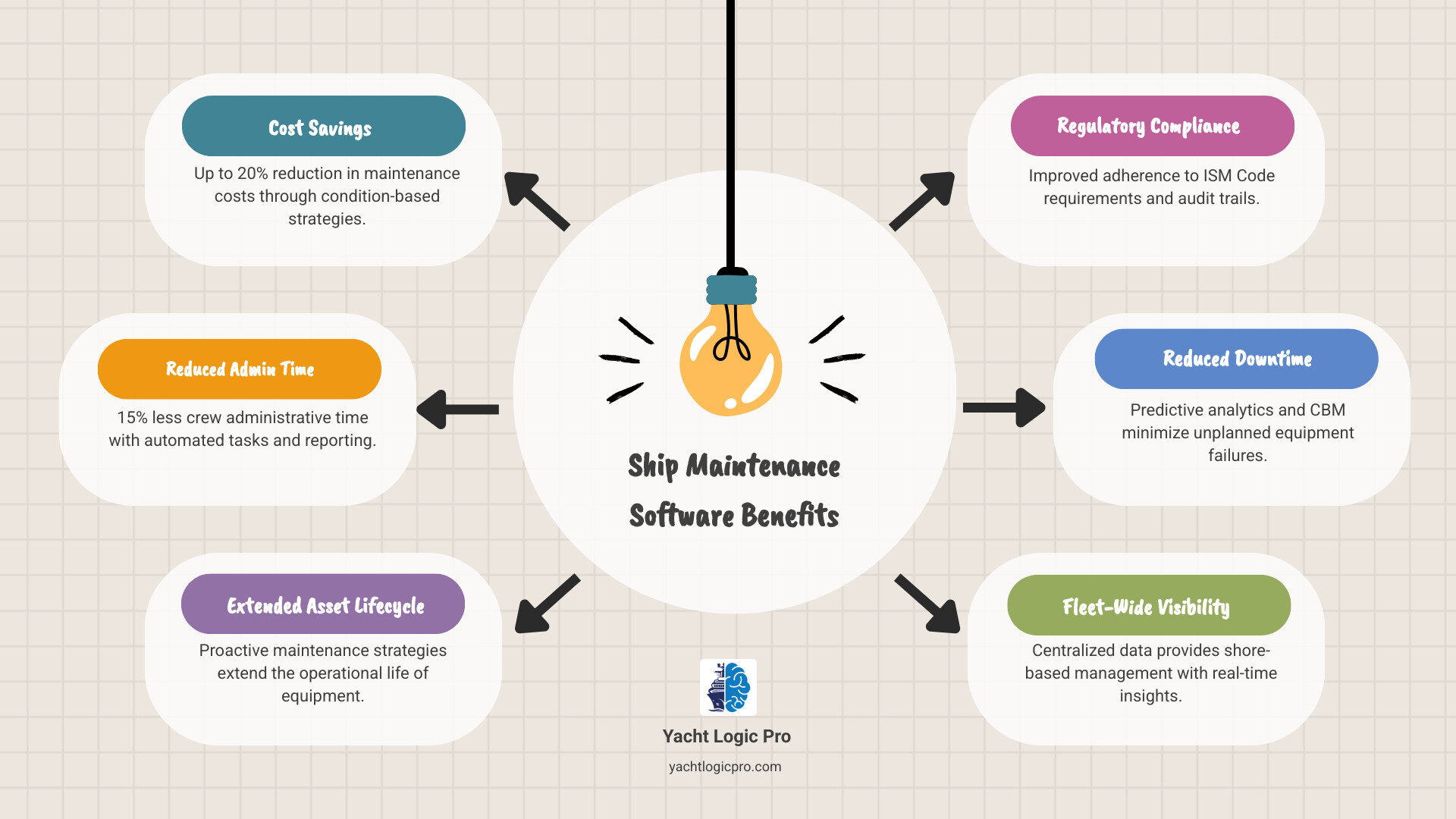
The stakes are high. A planned maintenance system isn’t just a convenience—it’s mandatory under the International Safety Management (ISM) Code, established by the International Maritime Organization. Beyond compliance, effective maintenance software directly impacts your bottom line: the research shows you can reduce crew administrative time by up to 15% and cut maintenance costs by up to 20% through condition-based strategies and better planning.
Safety, efficiency, and profitability are all connected. When maintenance is reactive rather than proactive, you risk equipment failure, costly downtime, and even regulatory fines. Modern software shifts the equation by giving you visibility into asset health, automating routine tasks, and enabling data-driven decisions that extend equipment lifecycles and maximize uptime.
I’m Kevin Kates, founder of Yacht Logic Pro, where I’ve spent years helping yacht owners and marine businesses implement systems that streamline operations and improve vessel performance. Having worked directly with ship maintenance software across various fleet sizes, I understand the real-world challenges of choosing and deploying the right solution for your operation.
The Engine Room: Core Functionalities of Modern Ship Maintenance Software
Think of modern ship maintenance software as the vessel’s digital “engine room”—a centralized hub where every critical operation is monitored, managed, and optimized. These powerful platforms are far more than just glorified checklists; they are comprehensive systems designed to keep your fleet running smoothly, safely, and profitably. At their core, these solutions bring together a suite of functionalities that address the multifaceted demands of maritime operations.
Core functionalities typically include a robust Planned Maintenance System (PMS), sophisticated inventory management, streamlined procurement processes, and intelligent reporting tools. Together, these elements work to reduce operational costs, prevent costly downtime, and significantly extend the lifecycle of valuable vessel equipment. By providing a holistic view of your assets, these systems empower us to make fast, data-driven decisions that protect our investments and improve overall efficiency.
Planned Maintenance and Regulatory Compliance
One of the cornerstones of any effective ship maintenance software is its Planned Maintenance System (PMS). This isn’t just a nice-to-have feature; it’s a critical component for ensuring the safety and operational reliability of our vessels, and it’s mandatory according to the International Safety Management (ISM) Code. A well-implemented PMS allows us to plan, perform, and carefully document all vessel maintenance activities at intervals that strictly comply with Class and manufacturer requirements.
Modern software automates scheduling, changing what was once a tedious, manual process into an efficient, predictable workflow. This includes generating work orders based on time, operating hours, or even condition-based triggers. When a defect is reported, the system allows for quick logging, prioritization, and tracking to resolution, ensuring nothing falls through the cracks. This systematic approach, often based on risk assessment, not only streamlines operations but also ensures we meet safety and environmental objectives. Having a comprehensive, digital record of every task, inspection, and repair means we’re always audit-ready, proving compliance to regulators and customers alike. For more on keeping meticulous records, check out our insights on How to Create Repeat Business with Better Yacht Service Records.
Inventory, Spares, and Procurement
Imagine trying to find a critical spare part in a hurry, only to find it’s out of stock or, worse, lost in a sea of unorganized inventory. That’s a nightmare scenario that modern ship maintenance software is designed to prevent. Centralized inventory control is a game-changer, providing unprecedented visibility into spare parts and consumables across our entire fleet. We can track every nut, bolt, and filter, managing inventory locations and the entire lifecycle of each part.
Beyond just tracking, these systems streamline procurement. They can automate purchasing processes, generate requisitions when stock levels run low, and even track the costs associated with each part and service. This integration means we can optimize our stock levels, reducing carrying costs and minimizing the risk of expensive rush orders. By connecting maintenance needs directly to procurement, we ensure that the right parts are available at the right time, preventing delays and keeping our vessels operational. If you’re still relying on manual tracking, you might be surprised by The Hidden Costs of Manual Yacht Maintenance Tracking.
Proactive and Predictive Maintenance Strategies
Gone are the days when maintenance was primarily a reactive affair—waiting for something to break before fixing it. Today’s ship maintenance software empowers us to accept proactive and predictive strategies, shifting from crisis management to strategic asset optimization.
- Condition-Based Maintenance (CBM): This approach triggers maintenance tasks based on the real-time condition of equipment, often integrating with sensors and monitoring devices. Instead of replacing a part every X hours regardless of its actual wear, CBM allows us to service it only when necessary, saving costs and maximizing its lifespan. Research indicates that implementing CBM can lead to up to 20% savings in maintenance costs.
- Predictive Analytics: Taking CBM a step further, predictive analytics uses historical data, machine learning, and sometimes AI to forecast when critical equipment might fail. By identifying potential failure points before they occur, we can schedule maintenance during planned downtime, avoiding unexpected breakdowns and costly emergency repairs.
- Real-time Monitoring: Many systems collect real-time data from onboard systems and IoT devices, providing shore-based teams with instant insights into asset conditions. This continuous oversight allows for prompt identification of potential issues and preventive actions.
By leveraging these advanced strategies, we can extend the lifecycle of our vessel equipment, reduce operational expenditure, and ensure the safety and reliability of our fleet. This data-driven approach is truly the future of marine operations, as we discuss in Why Data-Driven Yacht Service is the Future of the Marine Industry.
Dry-Docking and Major Project Management
Dry-docking is notoriously one of the most complex and expensive aspects of ship management. Schedules can slip, costs can spiral, and reporting often lags behind reality. Thankfully, ship maintenance software has evolved to tackle these monumental tasks, changing potential headaches into manageable projects.
Dedicated dry-docking modules within these systems provide comprehensive tools for project planning, allowing us to define requirements, draft detailed technical specifications, and create structured templates for tasks and jobs. They facilitate side-by-side comparison of yard quotations, enabling us to negotiate better deals and track billed versus budgeted costs with precision. Real-time progress monitoring and exception alerts help us spot risks early, ensuring projects stay on track and within budget. Some solutions even offer unlimited projects per vessel under a simple annual subscription, providing flexibility for ad-hoc repairs, intermediate surveys, and retrofits without charging per project. This level of control, transparency, and data for future docking cycles is invaluable.
Navigating Your Options: A Comparison of Software Types
Choosing the right ship maintenance software can feel like navigating a complex strait. The market offers a diverse range of solutions, each with its own strengths and ideal use cases. Understanding the differences between standalone tools, integrated suites, and the emerging AI-powered platforms is crucial for making an informed decision that aligns with our operational needs and future goals.
| Feature / Type | Standalone Tools | Integrated Suites | AI-Powered Platforms |
|---|---|---|---|
| Data Sync | Manual/Limited | Automated & Centralized | Automated & Intelligent |
| Automation | Basic task scheduling | Extensive workflow automation | Predictive, adaptive, self-optimizing |
| Scalability | Limited, can become cumbersome | Good, grows with fleet size | Excellent, learns and adapts |
| Reporting | Basic, siloed | Comprehensive, fleet-wide | Advanced analytics, prescriptive |
| Collaboration | Difficult | Streamlined ship-to-shore | Improved, data-driven |
| Proactive Maint. | Manual CBM | CBM & basic predictive | Advanced predictive, prescriptive |
| Cost Efficiency | Initial low, higher long-term | Good, reduced admin & downtime | Optimal, significant savings |
Standalone Tools vs. Integrated Suites
Historically, many operations relied on a patchwork of standalone tools—one for maintenance, another for inventory, maybe a spreadsheet for compliance. While these individual tools might be effective at their specific function, their limitations become glaring when we consider the bigger picture. Data lives in silos, requiring manual entry and reconciliation, which is not only time-consuming but also prone to errors. This fragmented approach makes it incredibly difficult to get a holistic view of fleet performance or to prove compliance efficiently.
This is where integrated ship maintenance software suites shine. They bring all critical functions—maintenance, inventory, procurement, safety, crewing, and even dry-docking—under one roof. The benefits are substantial:
- Single Source of Truth: All data is centralized, ensuring consistency and accuracy across the organization.
- Streamlined Workflows: Information flows seamlessly between modules, eliminating manual data entry and reducing administrative burden.
- Improved Efficiency: By unifying systems, we can optimize processes, reduce duplication of effort, and free up our crew to focus on essential work.
- Improved Visibility: Shore-based teams gain a comprehensive, real-time overview of fleet health, compliance status, and operational costs.
Compared to generic tools, marine-specific integrated software truly understands the unique demands of our industry. Learn more about why this matters in Tech That Works at Sea: Why Marine-Specific Software Beats Generic Tools Every Time.
The Impact of Integrated Ship Maintenance Software on Operations
The impact of integrated ship maintenance software extends far beyond simple task management. It fundamentally transforms how we operate, creating a more cohesive, efficient, and resilient maritime business.
- Connecting the Dots: By linking maintenance data with crewing schedules, procurement orders, and financial systems, we create a powerful ecosystem. This means a planned maintenance task can automatically trigger a parts requisition, which then updates inventory and impacts the budget. Crew availability can be factored into scheduling, optimizing resource allocation.
- Fleet-Wide Visibility: Integrated systems provide a centralized view of all vessels, allowing fleet managers to monitor performance, identify trends, and make strategic decisions across the entire operation. This bird’s-eye view is crucial for understanding overall asset health and operational efficiency.
- Improved Ship-to-Shore Collaboration: Effective communication is the lifeline of maritime operations. Integrated software facilitates seamless information exchange between ship and shore teams, ensuring everyone is working from the same, up-to-date information. This could be through integrated messaging, shared dashboards, or mobile updates that sync instantly.
- Data Consistency: With a single database powering all modules, we eliminate discrepancies that often arise from disparate systems. This consistency is vital for accurate reporting, compliance, and informed decision-making.
Integrated software acts as the digital backbone connecting every aspect of our marine business, from the dock to the dashboard, as we explore further in From Dock to Dashboard: How Yacht Logic Pro Connects Your Entire Marine Team.
The Rise of AI-Powered Platforms
The next frontier in ship maintenance software is the integration of Artificial Intelligence (AI). These AI-powered platforms are not just automating existing processes; they are introducing new levels of intelligence, efficiency, and predictive capabilities that were previously unimaginable.
- AI-Driven Failure Prediction: Beyond traditional predictive maintenance, AI can analyze vast amounts of data—from sensor readings and historical maintenance logs to weather patterns and operational profiles—to identify subtle anomalies and forecast equipment failures with remarkable accuracy. This allows for truly proactive maintenance, often before any human could detect an issue.
- Automated Technician Scheduling: AI can optimize technician schedules, considering factors like crew availability, skill sets, regulatory requirements, and the criticality of tasks. This not only improves efficiency but also ensures the right person is assigned to the right job at the right time.
- Optimizing Resource Allocation: AI can help us make smarter decisions about spare parts, fuel consumption, and operational routes by continuously learning from real-world data. This leads to significant cost savings and improved operational outcomes.
For service-driven marine businesses, an all-in-one, AI-powered solution can be a game-changer. It automates maintenance, intelligently manages technicians, tracks inventory, and syncs finances, unifying operations and eliminating manual data entry. This comprehensive approach streamlines the entire yacht service workflow, from the first call to the final invoice, boosting profits and saving invaluable time. Find how this change happens in From First Call to Final Invoice: Streamlining the Yacht Service Workflow.
Your Buyer’s Checklist: Key Considerations for Choosing a Solution
Selecting the ideal ship maintenance software is a significant investment, one that will impact our operations for years to come. It’s not a decision to be taken lightly, and approaching it with a clear checklist of considerations will help us steer the options and find a solution that truly fits our unique needs.
How to Choose the Right Ship Maintenance Software
When evaluating solutions, we need to look beyond the flashy features and focus on practical functionality and long-term value.
- User-Friendliness: This is paramount. If the software isn’t intuitive and easy for our crew to use, adoption will be low, and the investment will be wasted. Look for clean interfaces, clear navigation, and minimal clicks to complete tasks. A solution designed “by technicians for technicians” often excels here.
- Mobile Access & Offline Capabilities: Our marine teams are rarely tethered to a desk. The ability to access and update work orders, inventory, and documentation from a tablet or smartphone, even when offline or with limited bandwidth, is critical. Data should sync seamlessly once connectivity is restored.
- Comprehensive Functionality: Does it cover all our core needs—planned maintenance, inventory, procurement, safety, reporting, and dry-docking? An all-in-one solution that reduces the need for multiple disparate systems is often more efficient.
- Reporting & Analytics: Can the software provide the insights we need to make informed decisions? Look for powerful reporting tools, customizable dashboards, and the ability to track key performance indicators (KPIs).
- Compliance Support: Does it actively help us meet regulatory requirements like the ISM Code, IHM, and other class society mandates? This includes features for certificate tracking, audit trails, and document management.
For a deeper dive into what to look for, consult What to Look For in Yacht Service Management Software: A Buyer’s Checklist.
Integration Capabilities and Scalability
Our vessels don’t operate in a vacuum, and neither should our software. A crucial consideration is how well the ship maintenance software integrates with our existing systems and its ability to scale with our growth.
- Integration with Other Systems: Can it connect seamlessly with our Enterprise Resource Planning (ERP) systems, accounting software, crewing software, or other specialized maritime applications? Look for solutions that offer robust API availability to ensure smooth data exchange and prevent information silos. For example, some systems connect to SCADA for real-time data or procurement platforms.
- Scalability: Whether we manage a small fleet or a large global operation, the software should be capable of growing with us. This means supporting an increasing number of vessels, users, and data volumes without sacrificing performance. Solutions that offer customizable modules and workflows are often more adaptable to different operational needs and vessel types.
- Flexibility for Different Vessel Types: Our fleet might consist of various vessel types—cargo, passenger, offshore, or even yachts. The software should be flexible enough to manage the unique maintenance profiles and regulatory requirements of each.
Choosing a scalable solution ensures our investment remains valuable as our business evolves. Learn how robust software supports growth in How Yacht Logic Pro Helps Boatyards Scale Without Sacrificing Quality.
Implementation, Training, and Support
Even the most advanced software is only as good as its implementation and the support behind it. This often-overlooked aspect can make or break the success of our digital change.
- Data Migration Process: How easy is it to transfer our existing data—equipment lists, maintenance histories, inventory records—into the new system? Look for vendors who offer experienced support and best practices for data migration to ensure accuracy and minimize disruption.
- Onboarding and Training Programs: A comprehensive training program for our crew and shore-based teams is essential for successful adoption. This could include online tutorials, in-person sessions, or dedicated support during the initial rollout. Some providers offer basic and advanced training custom to different user roles.
- Customer Support: What kind of support is available? Is it 24/7? Do we get to speak to human engineers, or are we stuck with chatbots and phone trees? Unparalleled customer support, available any time day or night, can be a lifesaver when critical issues arise. Many reputable providers have dedicated teams and offer prompt email responses.
- Vendor Reputation & Longevity: Consider the vendor’s track record. Companies that have been trusted by the maritime industry for decades, operating across many countries and vessels, often indicate stability and expertise.
A strong support system ensures that we can maximize our return on investment and that our teams can quickly become proficient users. Find how effective training can accelerate your team’s adaptation in How Yacht Logic Pro Helps Marine Businesses Train New Staff Faster.
Frequently Asked Questions about Ship Maintenance Software
We often hear similar questions from marine professionals considering the leap to digital maintenance management. Let’s address some of the most common ones.
How does this software help with regulatory compliance like the ISM Code?
Ship maintenance software is a compliance superpower! The International Safety Management (ISM) Code, along with other regulations like the Hong Kong Convention for IHM, mandates strict procedures for vessel safety and maintenance. Our software acts as a centralized repository for all compliance-related documentation. It helps us:
- Centralize Documentation: All manuals, certificates, procedures, and safety records are stored digitally and are easily accessible.
- Generate Audit Trails: Every action, every repair, every inspection is logged, creating an immutable audit trail that proves due diligence.
- Automate Alerts: It automatically notifies us of upcoming survey due dates, certificate expirations, and required maintenance intervals, ensuring we never miss a deadline.
- Standardize Procedures: We can create and enforce standardized maintenance jobs and checklists across the fleet, ensuring consistency and adherence to best practices.
- Prove Compliance: During audits, we can quickly access and present relevant data and KPIs, demonstrating our commitment to safety and regulatory adherence. Some systems even integrate directly with classification societies for streamlined audits.
Can this software really reduce my operational costs?
Absolutely! This isn’t just about efficiency; it’s about significant financial savings. Modern ship maintenance software impacts our bottom line in several key ways:
- Optimized Maintenance Scheduling: By moving from reactive repairs to planned and predictive maintenance, we avoid costly emergency repairs and reduce unscheduled downtime. This can lead to up to 20% savings in maintenance costs.
- Reduced Unplanned Downtime: Every hour a vessel is unexpectedly out of commission costs us money. By preventing failures, the software keeps our vessels operational and revenue-generating.
- Lower Inventory Costs: Precise inventory management means we carry fewer unnecessary spare parts, reducing storage costs and capital tied up in stock. We can also optimize procurement, leveraging data for better deals.
- Improved Fuel Efficiency: Well-maintained engines and systems run more efficiently, leading to reduced fuel consumption and lower operational expenses.
- Labor Cost Savings: Automation of administrative tasks, better scheduling, and improved communication can reduce crew time spent on admin work by up to 15%, allowing them to focus on essential tasks.
What’s the difference between planned, condition-based, and predictive maintenance?
These are three distinct, yet often complementary, strategies for keeping our equipment in top shape:
- Planned Maintenance (PM): This is maintenance scheduled at predetermined intervals, typically based on time (e.g., every 6 months) or usage (e.g., every 500 operating hours). It’s a foundational strategy to ensure routine servicing.
- Condition-Based Maintenance (CBM): Here, maintenance is performed only when indicated by monitoring the equipment’s actual condition. Sensors, visual inspections, or diagnostic tests trigger maintenance tasks when certain thresholds are met. It’s about fixing things when they need fixing, not just because a calendar says so.
- Predictive Maintenance (PDM): This is the most advanced form, using data analytics and often AI to forecast when a component is likely to fail. By analyzing trends, anomalies, and various operational parameters, PDM allows us to schedule maintenance precisely before a failure occurs, maximizing component life and minimizing downtime.
Modern ship maintenance software often supports all three strategies, allowing us to implement a sophisticated, multi-layered approach to asset management. We can schedule routine PM tasks, set up alerts for CBM triggers, and leverage advanced analytics for PDM, optimizing our maintenance efforts for maximum efficiency and cost-effectiveness.
Conclusion: Charting a Course for a More Efficient Future
The maritime industry is undergoing a profound change, and ship maintenance software is at the heart of this evolution. We’ve moved beyond the era of manual logs and reactive repairs, embracing a future where digital platforms empower us to manage our fleets with unprecedented precision and foresight. From ensuring regulatory compliance with the ISM Code to dramatically reducing operational costs and downtime, these solutions are indispensable for any modern marine business.
The shift from reactive to proactive management is not just a trend; it’s a necessity. By leveraging planned, condition-based, and predictive maintenance strategies, we can extend the lifecycle of our valuable vessel equipment, improve safety, and maintain a competitive edge. Integrated suites provide the holistic view and seamless collaboration needed between ship and shore, while the rise of AI-powered platforms promises even greater efficiencies through intelligent automation and predictive insights.
Choosing the right ship maintenance software is a strategic decision that requires careful consideration of user-friendliness, integration capabilities, scalability, and robust support. But make no mistake: the investment in a future-proof solution will pay dividends, ensuring our operations are not just surviving, but thriving in the digital age.
The future of marine service is digital, and we’re here to help you get ahead. To explore features that can revolutionize your marine operations, visit our Features page today and chart a course for a more efficient tomorrow.