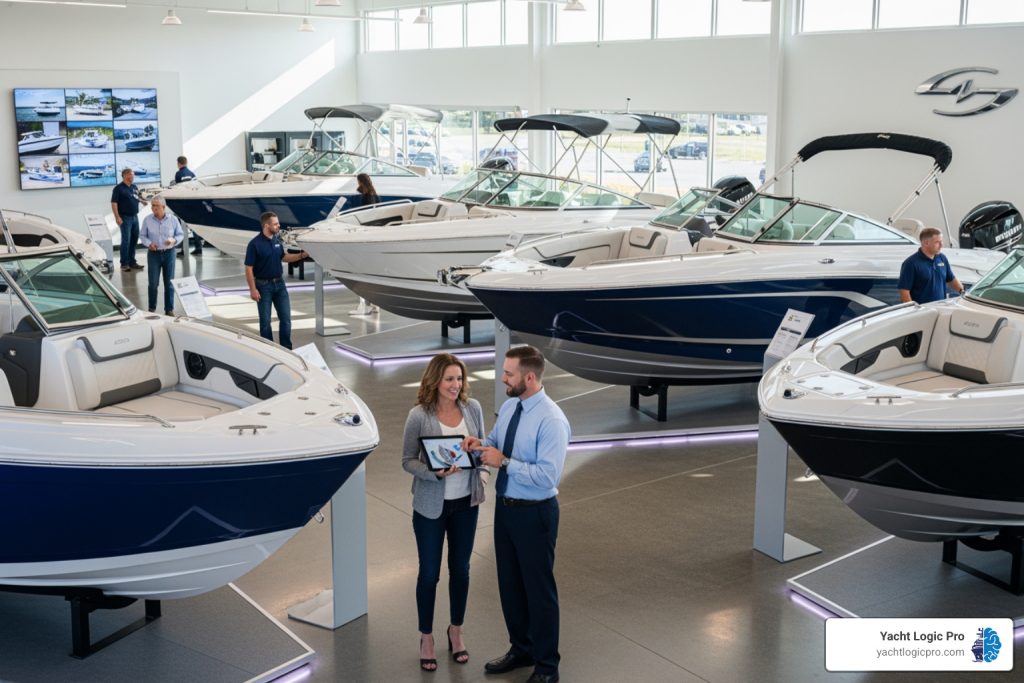


Running a boat repair shop is not just about knowing how to fix boats. The business side — quoting accurately, dispatching technicians, tracking parts, invoicing customers, and getting paid — determines whether a technically excellent shop is profitable or perpetually behind.
Most marine service businesses start with informal systems: a whiteboard for the schedule, a spreadsheet for inventory, QuickBooks for invoicing, and a folder of paper job tickets. These work at one or two technicians. They stop working when the shop starts to grow, and they make it nearly impossible to understand which jobs are profitable and which are not.
This article is for marine service business owners who are ready to replace informal systems with structured operations — without overhauling everything at once.
The Three Places Where Boat Repair Shops Lose Money Without Knowing It
Most operational inefficiency in marine service businesses is invisible until you start measuring it. Three areas account for the majority of uncaptured revenue:
Underpriced Labor on Complex Jobs
Marine repair work is inherently unpredictable. A straightforward engine service becomes complicated when the water pump housing is corroded, the hose connections have not been touched in six years, and the part that needs replacing is a two-day lead item. Shops that quote jobs without tracking actual hours against the estimate are systematically underpricing the complex work and only discovering the gap after the invoice is sent.
Job costing — tracking actual labor and parts costs in real time against the original quote — makes this visible at the job level. Over time, it reveals which job types consistently run over and by how much, which is the data you need to reprice them correctly.
Parts Ordered Twice or Not Ordered at All
Parts management is one of the most operationally expensive problems in a marine service business. Technicians order parts from memory, duplicates arrive, the wrong part is ordered for a similar job, and items ordered for one customer end up pulled for another. Without a structured inventory system, a shop with four technicians running concurrent jobs is essentially managing parts as a separate full-time job.
The fix is not a sophisticated warehouse system. It is a simple parts-to-job connection: every part ordered is attached to a specific job and a specific vessel, visible to everyone touching that work order, with incoming parts confirmed against what was ordered.
Time Spent Writing Up Jobs Instead of Working on Boats
For a shop running 20 to 40 active jobs per week, administrative time — writing up work orders, updating job status, creating invoices, following up on approvals — can consume a significant portion of the workday. When technicians and service writers are spending time on paperwork that could be automated, that time is coming directly out of billable hours.
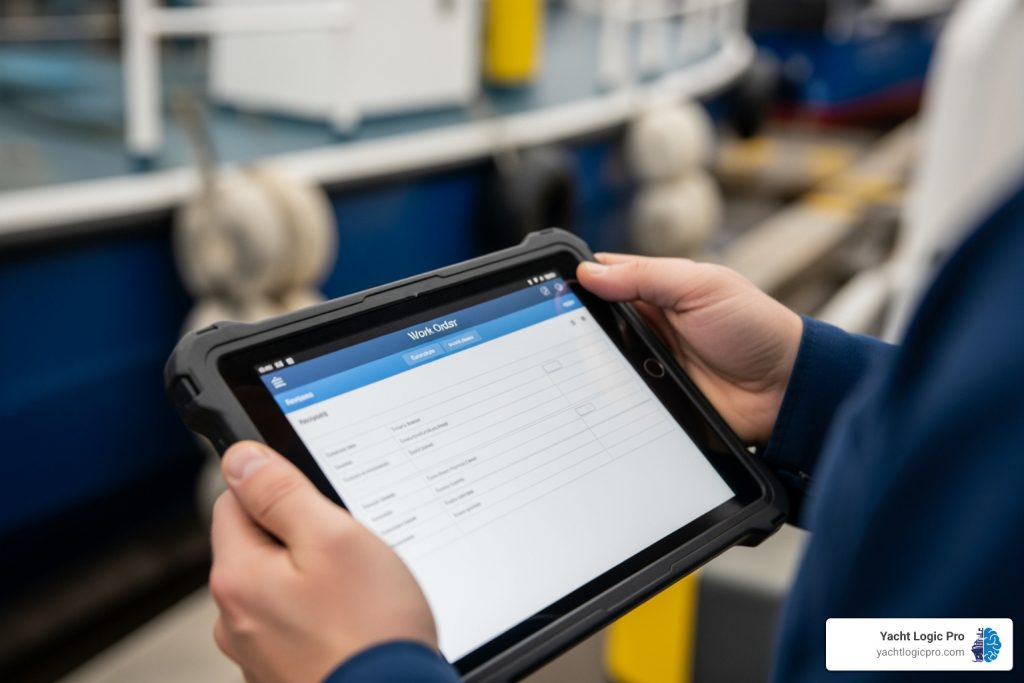
AI-powered job creation tools that generate a complete work order from a spoken or typed description have cut job write-up time dramatically for marine service businesses that have adopted them. The efficiency gain compounds when the same platform handles scheduling, parts, invoicing, and customer communication.
Operational Systems That Make the Difference
Fixing these three problems does not require a complete operational overhaul. It requires getting the right systems in place for each one. Here is what that looks like in practice:
Centralized Job Management
Every active job should have a single record that contains the vessel information, the quoted scope of work, parts ordered and received, technician time logged, job status, and all customer communications related to that job. When this information is fragmented across a whiteboard, a text thread, and a paper job ticket, the service writer cannot give a customer an accurate status update without walking to the shop floor.
Centralized job management also makes scheduling visible at the shop level — not just in a technician’s head. When every job is in the system with an assigned technician and expected duration, the person doing the scheduling can see actual capacity versus demand.
Real-Time Parts and Inventory Tracking
A functional parts system for a boat repair shop does not need to be complex. It needs to do four things:
- Connect parts to specific jobs and vessels so there is no ambiguity about what was ordered for whom
- Track parts on hand so technicians can confirm availability before committing to a timeline
- Flag when fast-moving items are running low before they cause a delay
- Record parts usage against jobs so the cost is captured in job costing
Barcode scanning at receiving and at parts pull dramatically reduces data entry errors and gives a shop an accurate real-time inventory without manual counts.
Digital Customer Approvals
Work authorizations that require a customer’s physical signature slow down jobs. Owners are often not on-site, and waiting for a callback to start work creates scheduling gaps. Digital approval workflows — where the customer receives a work authorization by text or email and signs electronically — remove this friction without reducing the legal protection of a signed authorization.
For shops that have adopted digital approvals, the time between diagnostic completion and work start has shortened significantly, and customer satisfaction scores for communication have improved because the approval process creates a natural touchpoint.
Time Tracking Against Jobs
Time tracking at the job level is the data foundation for accurate labor pricing. Technicians clocking in and out of specific jobs — rather than just clocking in and out of the workday — gives the shop the information it needs to understand true job cost.
This is the same data used for payroll, for job profitability analysis, and for identifying which technicians are most efficient on which job types — information that drives better scheduling decisions over time.
| Marine service businesses that replace informal systems with structured job management, parts tracking, and digital workflows typically see a measurable reduction in parts ordering errors and a meaningful increase in labor revenue capture within the first quarter of implementation. |
Choosing Software Built for Marine Service Businesses
Generic field service management platforms — the ones used by HVAC companies, plumbers, and landscapers — can handle basic job management and invoicing. What they cannot do is store a vessel’s full service history, track engine hours across visits, generate marine-specific work orders, or connect to the workflow of a shop where every customer asset is a boat with a hull ID and a specific service record.
For marine service businesses, the cost of working around a generic platform adds up quickly. Custom fields that do not match the industry, workarounds for vessel-specific data, and missing integrations with marine suppliers are friction points that grow as the business grows.
Yacht Logic Pro is designed specifically for the operational reality of a marine service business. The platform includes:
- AI-powered job creation — dictate or type a description, get a complete work order
- Vessel profiles with full service histories accessible from any job
- Preventive maintenance scheduling with automated customer reminders
- Parts and inventory management with barcode scanning
- YachtSign Pro — built-in digital approvals at no extra cost
- Time tracking and job costing built into every work order
- QuickBooks Online sync for accounting integration
- Mobile app for technicians working dockside or at remote locations
The platform is built by marine industry professionals and priced for independent and mid-size marine service businesses — starting at $99/month with no setup fees and no hidden costs.
| See Yacht Logic Pro in Action Book a live demo at Yacht Logic Pro. |
Frequently Asked Questions: Running an Efficient Boat Repair Shop
What software do boat repair shops use to manage jobs and invoices?
Boat repair shops use either generic field service management platforms (like Jobber or Housecall Pro) or marine-specific software like Yacht Logic Pro. Marine-specific platforms store vessel profiles, track service histories per hull, and handle marine-specific job types — things generic tools are not built to do.
How can a marine service business reduce time spent on paperwork?
Marine service businesses reduce paperwork by centralizing job creation, invoicing, and customer communication in a single platform. AI-powered job creation tools let technicians dictate or type a quick description and have a full work order generated automatically, cutting job write-up time significantly.
What is job costing for marine repair shops and why does it matter?
Job costing tracks actual labor hours and parts costs against the quoted price for each job. For marine repair shops, where jobs frequently run over on parts or time, accurate job costing reveals which job types are profitable and which are consistently underpriced — giving shops the data to make faster and more accurate pricing decisions.
Is Yacht Logic Pro good for small boat repair shops?
Yes. Yacht Logic Pro is designed for marine service businesses of all sizes — from solo mobile marine technicians to multi-bay boat repair shops. The platform starts at $99/month for a single user and includes job management, invoicing, preventive maintenance scheduling, and AI-powered work order creation with no setup fees or hidden costs.