
The Hidden Costs of Manual Yacht Inventory Tracking
Automated inventory counts are technology-driven systems that use barcoding, RFID, software, and sometimes robotics or AI to track and monitor stock levels in real-time without manual intervention. Instead of relying on periodic physical counts with clipboards and spreadsheets, automated systems continuously update inventory records as items move in and out, achieving accuracy rates up to 99.9% compared to manual methods that typically reach only 65-70%.
Key features of automated inventory counts:
- Real-time tracking – Inventory updates instantly as items are scanned or moved
- Higher accuracy – Up to 99.9% accuracy vs. 65-70% for manual counts
- Faster processing – Can be 10x faster than manual counting methods
- Reduced labor costs – Eliminates need for full operational shutdowns and extensive staff hours
- Better forecasting – Data-driven insights prevent stockouts and overstocking
- Continuous monitoring – Replaces annual or periodic “all-hands-on-deck” counting events
If you run a marine service business, you know the frustration of not knowing exactly what parts you have on hand. Manual inventory tracking means lost billable hours, emergency orders that eat into margins, and technicians waiting around for parts that may or may not be in the storeroom. Every misplaced fuel filter or uncounted impeller represents both lost revenue and diminished customer confidence.
The marine industry faces unique inventory challenges. Parts are expensive, specialized, and often hard to source quickly. When your team is manually tracking hundreds or thousands of SKUs across multiple locations, inaccuracy isn’t just possible—it’s inevitable. Manual counting processes are prone to errors, require operational shutdowns, and consume valuable technician time that could be spent on billable work.
I’m Kevin Kates, founder of Yacht Logic Pro, and I’ve helped marine service businesses transform their operations through strategic use of technology. Throughout my work with yacht management companies and service providers, I’ve seen how automated inventory counts can eliminate the costly errors and inefficiencies that plague manual tracking systems.
The Shift from Manual Tallies to Automated Precision
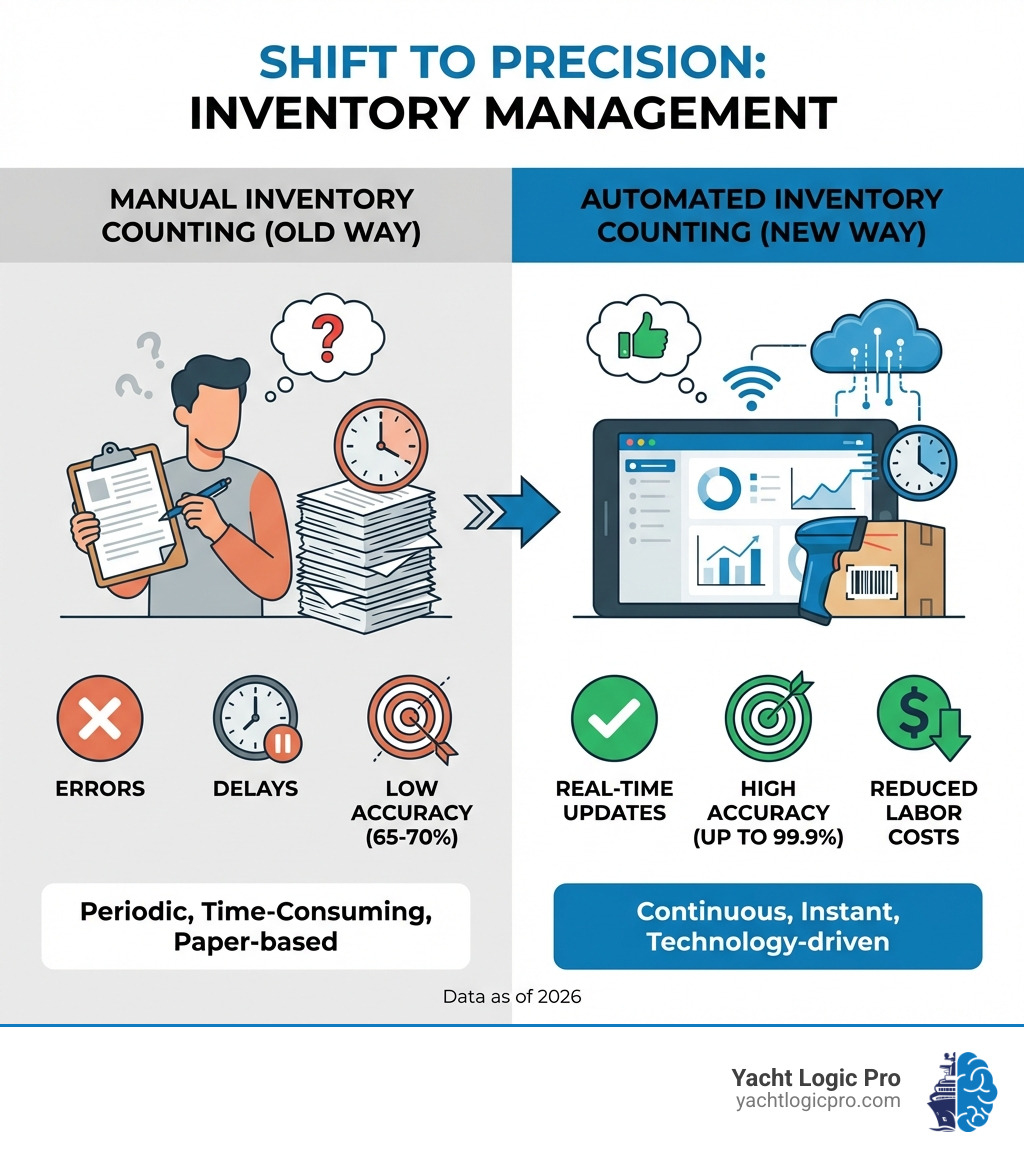
For too long, businesses have grappled with the tedious and error-prone nature of manual inventory counting. This traditional method, often involving clipboards, spreadsheets, and countless hours, typically results in an accuracy rate of around 65% to 70%. Imagine trying to run a tight ship with 30-35% of your inventory data being unreliable! This “visibility gap” can truly make or break a business, leading to significant discrepancies that impact operations and customer satisfaction.
Manual inventory counting isn’t just slow; it’s a major drain on time and resources. It frequently necessitates operational shutdowns, bringing productivity to a halt while staff painstakingly count every item. As our research shows, improper manual counting processes are gateways to inventory inaccuracy and order fulfillment errors, both of which are the enemy of any successful inventory management program.
This is where automated inventory counting steps in as a game-changer. It’s a modern approach that leverages technology to accurately track and monitor stock levels in real-time, effectively eliminating manual data entry and drastically reducing errors. Instead of periodic, disruptive counts, automated systems offer continuous, accurate insights into your inventory.
Let’s take a quick look at how these two approaches stack up:
| Feature | Manual Inventory Counts | Automated Inventory Counts |
|---|---|---|
| Accuracy | Typically 65-70% | Often reaching 99.9% |
| Speed | Slow, time-consuming | Up to 10x faster |
| Labor Cost | High, requires significant staff hours | Reduced, frees up staff for strategic tasks |
| Operational Impact | Disruptive, often requires shutdowns | Minimal disruption, continuous operation |
| Data Real-time | Delayed, based on last count | Real-time, continuous updates |
| Error Rate | High, prone to human error | Very low, technology-driven precision |
| Scalability | Limited, becomes harder with growth | Highly scalable, adapts to business growth |
What is a Traditional Physical Inventory Count?
A traditional physical inventory count is an organized, methodical, and structured process used to count a business’s entire stock at a specific point in time. It’s an “all-hands-on-deck” effort, often performed annually or periodically, typically at the end of a reporting period. The goal is to verify inventory system data against what’s physically on hand.
While essential for financial reporting and auditing, these counts are notorious for being time-consuming and disruptive. They frequently require halting operations, which can be a significant setback for any business, especially in the busy marine service industry. Imagine telling your customers, “Sorry, we can’t service your yacht this week, we’re counting screws!” The process often relies on paper-based tracking, making it prone to human error—miscounts, incorrect recording of item quantity, location, or name.
How Automated Counting Transforms the Process
Automated counting completely transforms this cumbersome process. By leveraging advanced technologies, we move from disruptive, infrequent counts to continuous, real-time monitoring. This technology-driven approach minimizes human intervention, dramatically increasing accuracy levels, often reaching 99.9%.
Instead of shutting down, your operations can continue seamlessly while inventory is being counted. This continuous visibility means you always know what you have, where it is, and what you need, allowing for swift responses to market demands and operational needs. It’s a farewell to manual tallies—and a hello to smarter, more seamless operations.
Core Technologies Powering Automated Inventory Counts
At the heart of any effective automated inventory counting system lies a robust tech stack, designed to capture, process, and present data with unparalleled speed and accuracy. This isn’t just about scanning; it’s about intelligent integration and scalability. We’re talking about a symphony of hardware and software working in harmony to give you complete control over your stock.
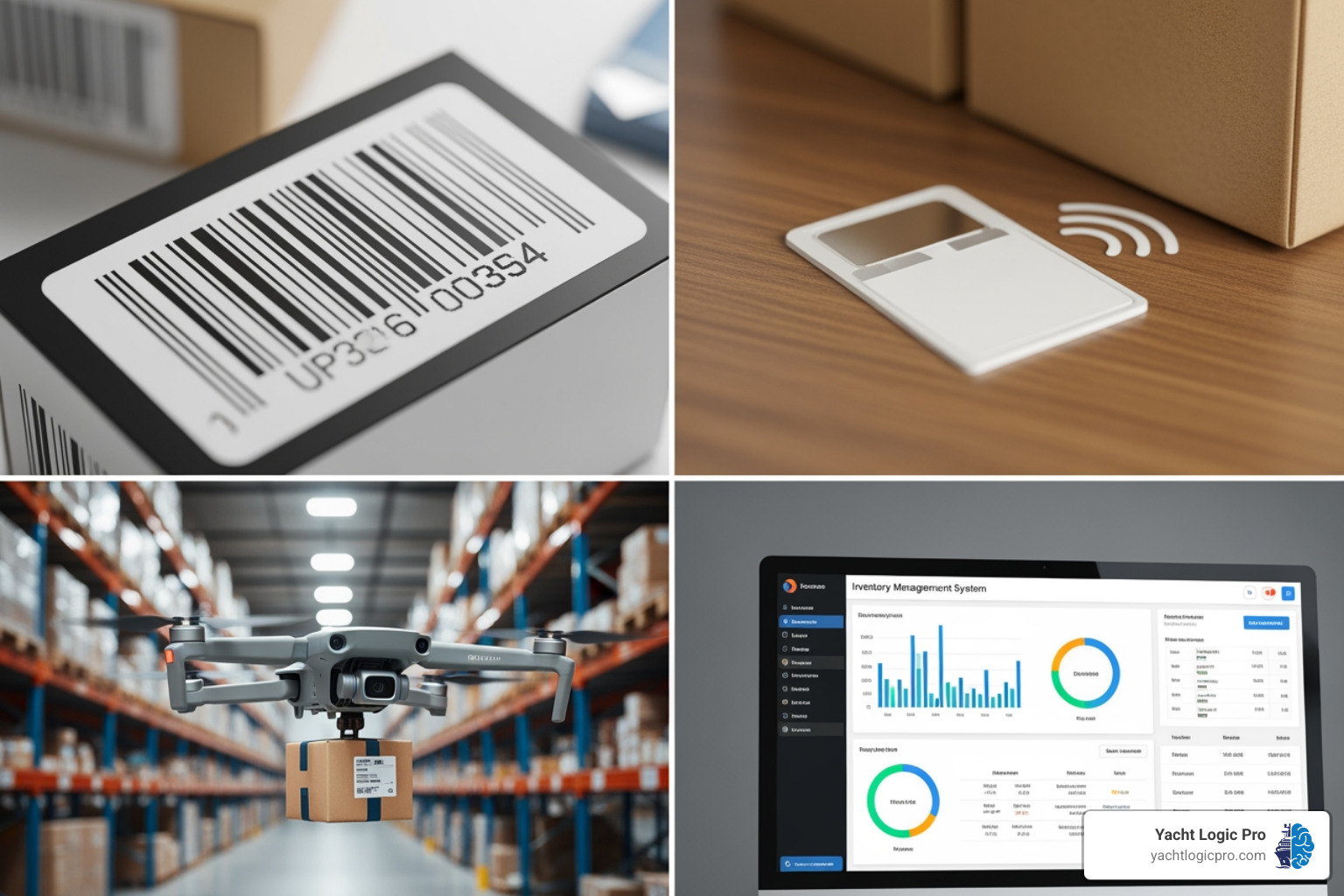
Barcoding and RFID: The Foundation of Data Capture
These technologies are the workhorses of automated data capture, forming the bedrock of any efficient system:
- Barcode Scanners and QR Codes: Tried and true, barcode scanners allow for quick and accurate data entry. By simply scanning a unique barcode or QR code attached to each item, inventory levels are instantly updated. This eliminates manual keying errors and significantly speeds up the counting process.
- RFID Tags: Radio-Frequency Identification (RFID) takes it a step further. These tags contain electronically stored information that can be read without direct line-of-sight. Imagine simply walking through a storeroom, and a gate reader automatically scanning every item in your cart or on your shelves, updating your inventory in real-time. This “scan-free” visibility, using battery-free IoT Pixels and area-based infrastructure, offers continuous inventory visibility across all defined areas. Such systems provide automated, continuous inventory visibility, dramatically increasing accuracy compared to manual methods.
- Handheld Devices: Modern automated systems often run on standard smartphones and tablets, changing everyday devices into powerful inventory tools. This means no specialized, expensive hardware is required, making implementation more accessible.
Inventory Management Software: The Central Brain
While barcodes and RFID tags handle data capture, inventory management software is the central intelligence that makes sense of it all. It acts as the nerve center, processing raw data into actionable insights.
- Centralized Database & Real-time Updates: This software maintains a single, accurate record of all your inventory across multiple locations. Every scan, sale, or transfer instantly updates this central database, providing real-time visibility into your stock levels.
- ERP Integration: For comprehensive business management, seamless integration with your Enterprise Resource Planning (ERP) system is crucial. This ensures that inventory data flows effortlessly into other critical business functions like finance, purchasing, and sales, eliminating data silos and manual reconciliation.
- Reporting and Analytics: Beyond simple counting, the software provides powerful reporting and analytical tools. These insights help you understand inventory trends, identify slow-moving items, and optimize stocking levels.
- Multi-location Tracking: For businesses with multiple workshops, service vans, or storage facilities, the software enables accurate tracking of inventory across all locations, ensuring you always know where every part is. We believe in Tech That Works at Sea: Why Marine-Specific Software Beats Generic Tools Every Time, and marine-specific software is designed to handle the unique complexities of our industry.
The Future is Now: AI, Drones, and Robotics
The evolution of automated inventory counts is accelerating with the integration of cutting-edge technologies:
- Computer Vision and On-Device AI: Some systems use “Spatial Vision” technology, which sees and understands inventory in 3D. Running entirely on standard smartphones and tablets, this on-device AI can instantly recognize and count items with 99% accuracy and can be 10x faster than manual counting. It can even operate in low-network or offline environments, a significant advantage for marine businesses.
- Autonomous Mobile Robots (AMRs): These robots steer warehouses, scanning barcodes and updating inventory records seamlessly. They free up human resources from manual tasks, allowing them to focus on more strategic activities.
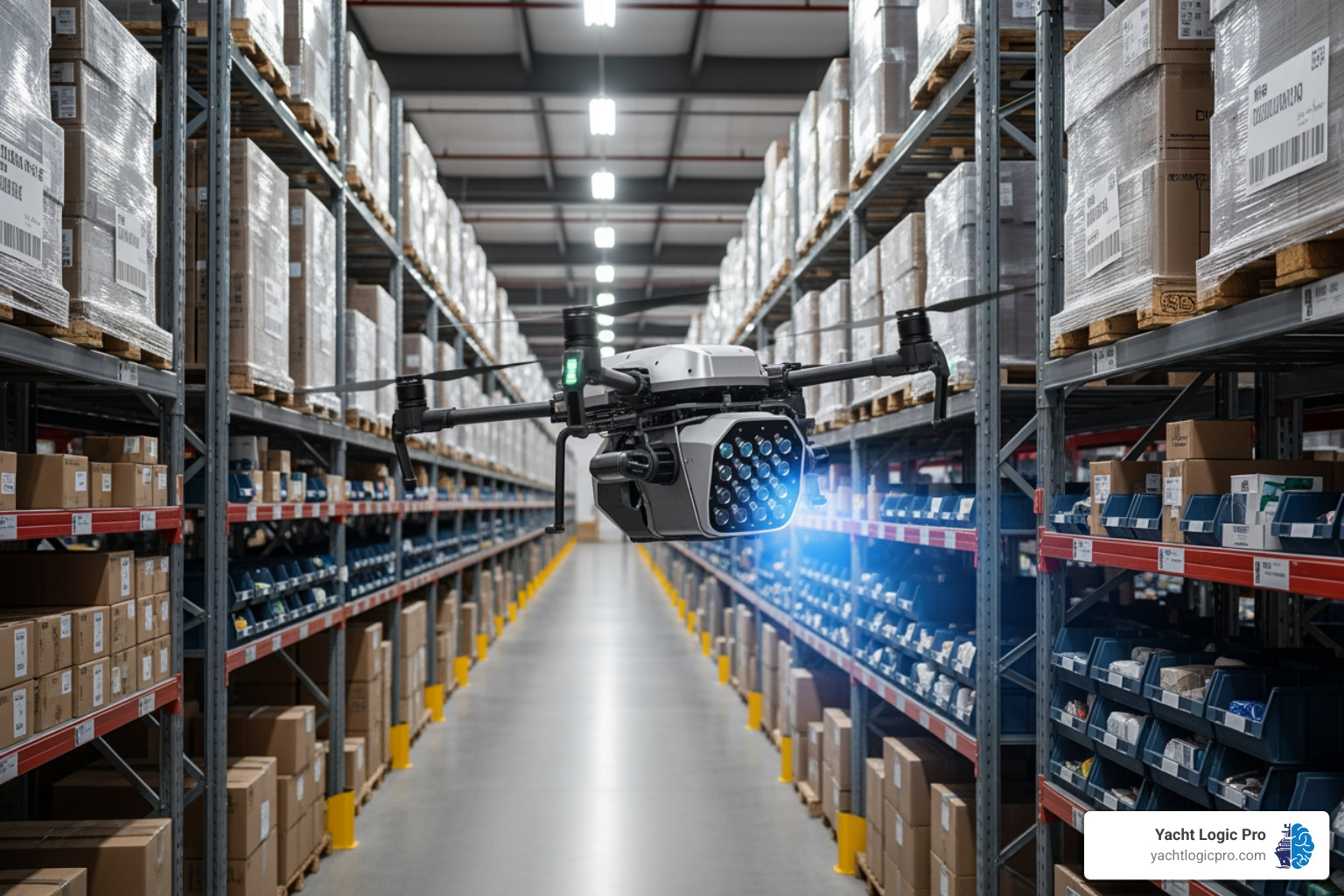
- Drones for Automated Counting: Drones equipped with cameras and sensors are increasingly being deployed in large warehouses. They can fly through aisles, capture images, and use computer vision to count inventory, significantly reducing manual labor and time. Our research indicates that drones for automated counting are a growing trend.
- Smart Shelving: IoT devices embedded in shelving can continuously monitor stock levels, triggering alerts or even automatic reorders when items run low, all without human intervention.
- Predictive Analytics: Powered by AI and machine learning, these tools analyze historical data to forecast demand more accurately, optimize stock levels, and prevent costly stockouts or overstocking.
Opening up Key Business Benefits
Implementing automated inventory counts isn’t just about adopting new technology; it’s about open uping a cascade of benefits that improve your bottom line, sharpen your competitive advantage, and ultimately boost customer satisfaction. When you know exactly what you have, you can serve your customers better, faster, and more profitably.
Achieving Near-Perfect Accuracy and Efficiency
The most immediate and impactful benefit is the dramatic increase in accuracy. While manual counting struggles to hit 70%, automated systems routinely achieve accuracy levels of 99% to 99.9%. This near-perfect precision virtually eliminates human error, which in turn leads to a host of other advantages:
- Reduced Labor Costs: By automating repetitive and time-consuming counting tasks, you significantly reduce the labor associated with manual data entry and stock-taking. This frees up your valuable technicians and staff to focus on billable work and customer service, rather than hunting for parts or endlessly recounting. Our research shows that automation can lead to significant cost savings.
- 10x Faster Counting: AI-powered systems are reportedly 10x faster than manual counting. Imagine completing a full inventory check in minutes instead of hours or days!
- Increased Productivity: With fewer errors and faster processes, your entire operation becomes more productive. Inventory discrepancies, which can cause significant delays in maintenance and repair, are minimized, allowing for smoother workflows.
Enhancing Forecasting and Strategic Decision-Making
Beyond efficiency, automated inventory counts provide the robust data needed for superior strategic planning:
- Data-Driven Insights: Real-time, accurate inventory data feeds into powerful analytics, giving you unparalleled insights into your stock movement, demand patterns, and consumption rates. This is the essence of Why Data-Driven Yacht Service is the Future of the Marine Industry.
- Preventing Stockouts and Overstocking: Globally, 8% of inventory perishes or is discarded annually at a cost of $163 billion. Automated systems, with their precise data and predictive capabilities, help you maintain optimal stock levels. This means fewer frustrating stockouts that delay repairs and upset customers, and less capital tied up in excess inventory gathering dust.
- Optimized Inventory Levels: By understanding true demand, you can fine-tune your inventory, reducing holding costs and improving cash flow. You’ll have the right parts at the right time, every time.
- Accurate Demand Planning: AI-powered predictive analytics can forecast demand more accurately, allowing you to make smarter purchasing decisions and ensure your supply chain is resilient and efficient.
The Strategic Role of Automated Cycle Counting
While a full physical inventory count can be disruptive, automated cycle counting offers a continuous, less intrusive approach to maintaining accuracy.
- Cycle Counting vs. Physical Counts: A cycle count involves counting a small, specific subset of inventory on a regular basis, rather than shutting down operations for a complete count. This continuous process helps maintain accuracy without the massive disruption of an annual physical inventory.
- Continuous Inventory Verification: Automated systems make cycle counting incredibly efficient. Instead of manual checks, technology can continuously verify inventory, flagging discrepancies as they occur.
- Reduced Operational Disruption: Because only a small portion of inventory is checked at a time, cycle counting minimizes the impact on daily operations. This is particularly beneficial for busy marine service centers.
- Identifying Discrepancies Faster: Continuous monitoring means errors or discrepancies are identified and rectified much quicker, before they snowball into larger, more costly problems. Automated cycle counting solutions, for example, can provide continuous counting without manual scanning, offering real-time tracking and discrepancy identification.
A Practical Guide to Implementation
Adopting automated inventory counts might seem like a daunting task, but with strategic planning and a phased rollout, it can be a smooth and highly rewarding transition. We’ve seen businesses transform their operations by embracing new technologies, and the marine industry is no exception. It’s about gaining buy-in from your team and understanding that this isn’t just a tech upgrade, but a fundamental improvement to your workflow. Think of it as From First Call to Final Invoice: Streamlining the Yacht Service Workflow – inventory is a key part of that seamless process.
How to Choose the Right Automated Inventory Counts Solution
Selecting the perfect solution for your business involves careful consideration of several factors:
- Assessing Business Needs: Start by understanding your current pain points. Are you struggling with frequent stockouts, excessive inventory, or constant miscounts? How many SKUs do you manage? Do you have multiple locations? Your specific challenges will guide your choice.
- Scalability for Growth: Choose a solution that can grow with your business. As your fleet of managed yachts expands or your service offerings diversify, your inventory system should be able to handle increased volume and complexity without requiring a complete overhaul.
- Integration Capabilities: Ensure the solution integrates seamlessly with your existing software, especially your accounting, CRM, and marine maintenance management systems. This prevents data silos and ensures a unified operational view. Look for systems with robust APIs for easy connection.
- User-Friendliness: A powerful system is only effective if your team can use it easily. Opt for intuitive interfaces and mobile accessibility, which encourages adoption and reduces training time.
- Total Cost of Ownership (TCO): Look beyond the initial purchase price. Consider ongoing subscription fees, maintenance, support, and potential hardware upgrades. A solution with a higher upfront cost might offer lower TCO in the long run through efficiency gains. Our guide on What to Look For in Yacht Service Management Software: A Buyer’s Checklist can provide further insights here.
Overcoming Common Challenges
While the benefits are clear, implementing automated inventory counts can come with its own set of problems:
- Upfront Investment vs. ROI: The perceived high upfront costs of automated systems can be a deterrent. However, many solutions now offer subscription models, making them more accessible. Crucially, the ROI can be significant and swift. Many providers report an ROI in less than one year on average, with potential for significant annual enterprise savings from labor reduction, improved availability, and optimized inventory levels.
- Employee Training and Adoption: Any new system requires proper training. It’s vital to explain the “why” behind the change – how it will make their jobs easier and more efficient, rather than just another chore. An employee-centric design with intuitive interfaces can significantly boost adoption.
- Data Migration: Moving existing inventory data to a new system can be complex. Plan for a careful and systematic migration process, potentially running parallel systems for a short period to ensure accuracy.
- Change Management: Resistance to change is natural. Communicate clearly, involve key team members in the decision-making process, and highlight the long-term benefits for everyone involved.
Success in Action: A Major Retailer’s Change
One of the most compelling examples of successful automated inventory counts comes from a major retailer: Starbucks. Facing the challenges of manual tallies across thousands of locations, they turned to an AI-powered inventory solution.
This solution, which runs on standard smartphones and tablets, allowed Starbucks to count inventory instantly, accurately, and as often as needed with just a wave of a device. The results were remarkable:
- Mobile-First Approach: Utilizing existing mobile devices eliminated the need for expensive, specialized hardware.
- 10x Speed Increase: Counts that once took significant time were completed dramatically faster.
- 99% Accuracy: Human error was virtually eliminated, leading to highly reliable inventory data.
- Improved Employee Experience: Deb Hall Lefevre, Starbucks Chief Technology Officer, noted, “It’s a farewell to manual tallies—and a hello to smarter, more seamless operations.” This improved experience likely contributed to better staff morale and efficiency.
- Automated Reordering (Future): The system is designed to not only identify low-stock items but also to automate restock orders, further streamlining operations.
This case study, highlighted in their press release, demonstrates the transformative power of AI-powered automated inventory counts in a high-volume, multi-location environment.
Frequently Asked Questions about Automated Inventory Counts
How often should we perform physical counts with an automated system?
Even with a highly sophisticated automated inventory counts system, periodic physical verification remains a best practice. While your automated system handles most of the heavy lifting, we recommend conducting a full physical inventory count at least once a year. This annual count serves as a crucial audit, allowing you to identify any discrepancies that might have slipped through and reconcile your digital records with physical reality. Use barcode scanner tools during these counts to eliminate human entry error.
For continuous accuracy, cycle counting should be integrated into your routine. Automated systems make cycle counting far more efficient, allowing you to verify specific inventory subsets much more frequently—even daily or weekly. This helps in identifying and resolving smaller discrepancies before they become major issues, significantly reducing the burden of the annual count.
Can small businesses and boatyards benefit from automation?
Absolutely! Automated inventory counts are not just for large enterprises. Small businesses and boatyards can significantly benefit from automation. Scalable solutions, often cloud-based, are readily available and can be custom to your specific needs and budget.
You can start small, perhaps by implementing barcode scanners and basic inventory management software. As your business grows, you can gradually introduce more advanced technologies like RFID or AI-powered mobile counting. The key is to choose a solution that aligns with your current operations and offers flexibility for future expansion. The gains in efficiency, accuracy, and reduced waste will quickly outweigh the initial investment, regardless of your size.
What is the typical ROI on an automated inventory system?
The Return on Investment (ROI) for an automated inventory counts system can be surprisingly fast, often achieved in less than one year. The savings come from several key areas:
- Labor Savings: Automating counting tasks drastically reduces the need for manual labor, freeing up staff for more productive activities.
- Reduced Stockouts: Accurate inventory data prevents stockouts, ensuring you always have the parts needed for repairs, which means faster service delivery and happier customers.
- Minimized Waste and Obsolescence: By optimizing inventory levels and improving forecasting, you reduce the risk of overstocking, which minimizes waste from expired, damaged, or obsolete parts. Globally, 8% of inventory perishes or is discarded annually.
- Improved Order Fulfillment: Knowing exactly what you have means faster and more accurate order fulfillment, enhancing customer satisfaction and boosting your reputation.
- Increased Sales: By preventing stockouts and ensuring parts availability, you can take on more jobs and complete them efficiently, directly leading to increased revenue.
These combined benefits often lead to substantial annual enterprise savings, making automated inventory systems a smart investment for long-term profitability.
Conclusion: Charting a Course for Smarter Inventory Management
As we’ve explored, automated inventory counts are no longer a luxury but a strategic necessity for businesses navigating the complexities of modern commerce. From achieving near-perfect accuracy and unprecedented efficiency to enhancing forecasting and empowering data-driven decision-making, the benefits are clear and profound. For marine service operations, where specialized parts, timely repairs, and customer satisfaction are paramount, this shift from manual to automated processes is especially critical.
At Yacht Logic Pro, we understand the unique challenges of the marine industry. That’s why our all-in-one, AI-powered marine maintenance and operations software is designed to bring these advantages directly to your boatyard or service center. We automate maintenance, manage technicians, track inventory with precision, and sync finances—all to unify your operations and eliminate the manual data entry that drains your time and profits.
By embracing automated inventory counts through a comprehensive platform like Yacht Logic Pro, you’re not just counting parts; you’re charting a course for smarter, more profitable, and resilient inventory management. It’s time to stop worrying about what’s in your storeroom and start focusing on what truly matters: delivering exceptional service to your clients.
Explore our full suite of features and find how we can help you streamline your stock and lift your marine service business.