
Why AI-Powered Maintenance is Changing Marine Operations
AI powered maintenance uses artificial intelligence to predict equipment failures before they happen, shifting operations from reactive repairs to proactive care. Instead of waiting for breakdowns or following rigid schedules, AI analyzes real-time data from sensors and historical records to tell you exactly when maintenance is needed.
Here’s what AI powered maintenance delivers:
- Predicts failures before they cause downtime
- Reduces maintenance costs by 10-40%
- Cuts unplanned downtime by up to 50%
- Extends asset lifespan by 20-40%
- Optimizes spare parts inventory automatically
- Improves safety by preventing dangerous failures
For marine business owners drowning in manual processes and lost revenue, this shift is critical. Traditional maintenance approaches leave you either fixing broken equipment in a panic or over-maintaining assets based on guesswork. Both eat into your bottom line.
AI powered maintenance changes the game. It consolidates data from engine sensors, maintenance logs, and operational history into a single view. Machine learning algorithms spot patterns humans miss—like subtle vibrations that signal an impending pump failure or temperature fluctuations that predict bearing wear.
The technology isn’t theoretical anymore. Modern manufacturers and energy operators are already saving hundreds of minutes of disruption each year and cutting energy costs using AI-driven maintenance and automated fault detection. Shop-floor and field data powered by AI and IoT has been shown to reduce breakdowns by around 70% and overall maintenance costs by about 25%.
This guide walks you through exactly how AI powered maintenance works, what technologies make it possible, and how to implement it in your marine operation—without getting lost in technical jargon.
From Traditional to Intelligent: Understanding the Maintenance Evolution
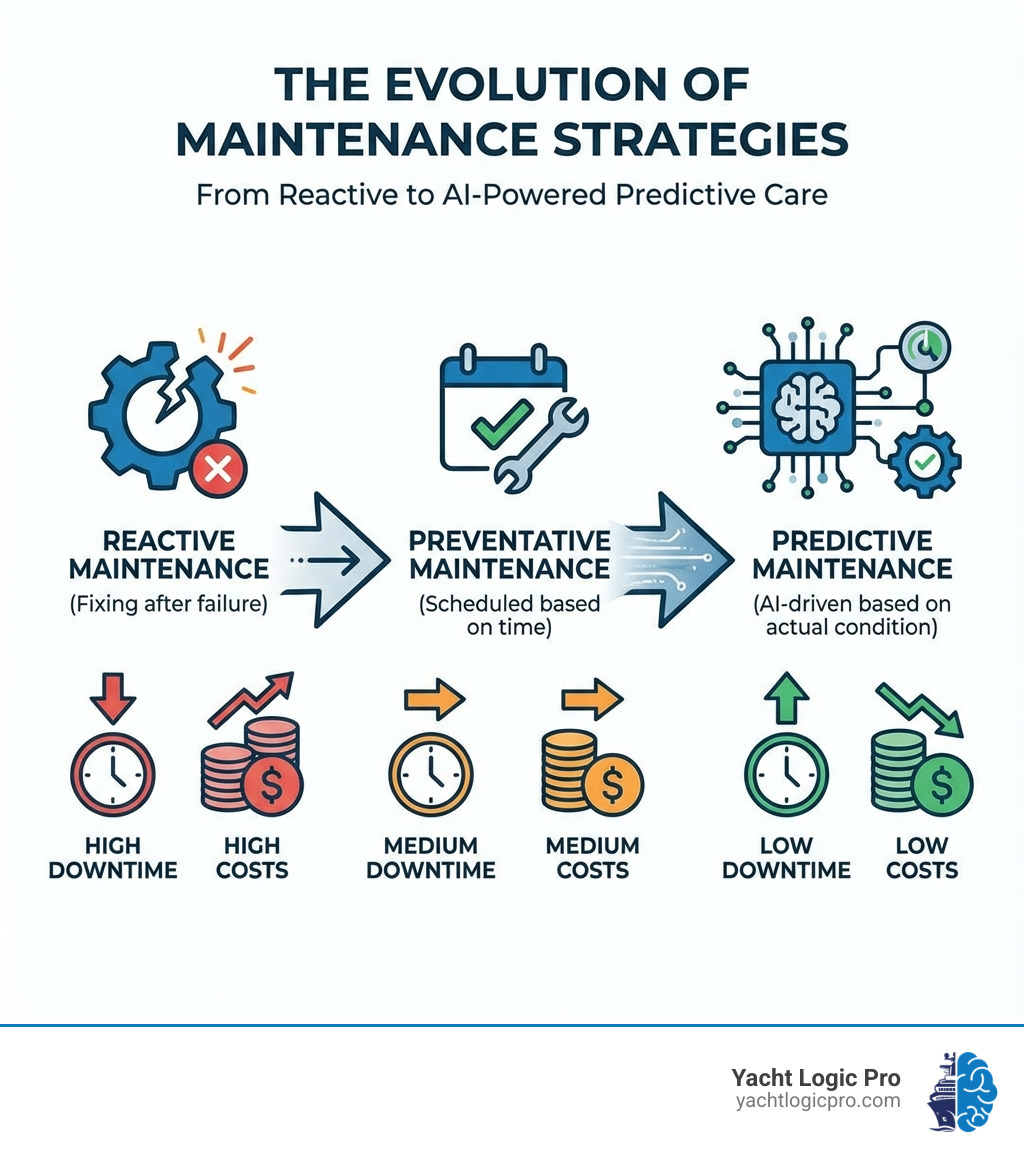
To understand AI’s impact, let’s first look at how maintenance has evolved. For centuries, it was a reactive scramble or a scheduled guess. Now, with AI, we can anticipate and prevent issues with remarkable accuracy. This shift isn’t just about new tools; it’s a fundamental change in how we approach asset longevity and operational efficiency.

Maintenance strategies exist on a spectrum, each with benefits and drawbacks. Understanding this spectrum is key to appreciating why AI powered maintenance is a game-changer. You can learn more about these different approaches in A guide to different maintenance models.
Reactive and Preventative Maintenance: The Old Guard
Let’s start with the “old guard” of maintenance:
Reactive Maintenance: This is the “run-to-failure” approach. Something breaks, and then you fix it. Imagine a yacht engine sputtering to a halt mid-cruise. This approach leads to costly, unplanned downtime, emergency repairs, and potential safety hazards. It’s stressful, inefficient, and chaotic. We’ve all been there, scrambling for a part or technician when critical equipment fails. The Hidden Costs of Manual Yacht Maintenance Tracking often stem from this reactive mindset.
Preventative Maintenance (PM): A step up from reactive, PM involves evaluating machinery at regular intervals based on historical data and supplier recommendations. Think of it like changing your car’s oil every 3,000 miles, regardless of how you drive. This creates rules-based schedules for tasks like inspections or part replacements. While better than waiting for a breakdown, PM can lead to “over-maintenance”—replacing parts that still have life in them or performing checks too frequently. It’s guided by broad recommendations from narrow datasets and fixed schedules, which can mean unnecessary labor and material costs.
Both reactive and preventative methods, while having their place, often result in either too much unplanned downtime or too much unnecessary maintenance. Neither is ideal for maximizing efficiency or profitability.
Predictive and Condition-Based Maintenance: The Proactive Shift
This is where things get exciting! Predictive maintenance (PdM) and condition-based maintenance (CBM) represent a significant proactive shift, especially when powered by AI.
Condition-Based Maintenance (CBM): Instead of following a rigid schedule, CBM monitors the actual condition of an asset to determine when maintenance is needed. It uses data from sensors to track parameters like vibration, temperature, and pressure. If a sensor detects an anomaly, it triggers a maintenance action. This is a vast improvement over preventative maintenance, as it prevents over-maintenance and acts only when necessary. You can explore more about Condition-monitoring techniques.
Predictive Maintenance (PdM) with AI: This is CBM on steroids. AI powered maintenance takes CBM a step further by using advanced algorithms to predict when a failure is likely to occur, often before any noticeable condition degradation. It doesn’t just react to an anomaly; it forecasts the probability and timing of a future failure. This means we can schedule maintenance precisely when it’s needed, minimizing disruption and maximizing asset lifespan.
The difference is crucial: preventative maintenance relies on broad recommendations and fixed schedules, potentially leading to over-maintenance. Predictive maintenance, on the other hand, uses continuous, real-time data from sensors and AI algorithms to build detailed models of equipment health. This allows for dynamic responses to anticipated problems, helping identify root causes and specific needed repairs, unlike the less flexible rules of preventative maintenance. It’s about being truly proactive, not just scheduled.
The Engine Room of AI Maintenance: Core Technologies and Data
So, how does this magic happen? At the heart of AI powered maintenance is a sophisticated interplay of data, sensors, and intelligent algorithms. It’s like giving your equipment a voice and a brain, allowing it to tell you its troubles before they become catastrophic. This data-driven approach is truly Why Data-Driven Yacht Service is the Future of the Marine Industry.
The Data Fueling the System
Imagine trying to diagnose an illness without any symptoms or medical history. Impossible, right? The same goes for machinery. AI needs data—lots of it, and good quality too—to make accurate predictions. This data comes from a variety of sources:
- IoT sensors: These are the eyes and ears of our AI system. Tiny, powerful sensors attached to critical equipment (like marine engines, generators, or HVAC systems) continuously collect real-time data. This includes:
- Vibration data: A change in vibration patterns can indicate bearing wear, misalignment, or imbalance long before a human can detect it.
- Temperature data: Unusual heat spikes or gradual temperature increases can signal friction, electrical issues, or fluid problems.
- Acoustic data: The subtle hum of a healthy pump sounds very different from the grinding of a failing one. AI can pick up on these nuances.
- Pressure and fluid levels: Monitoring these can reveal leaks, blockages, or operational inefficiencies.
- Historical Maintenance Records: Every repair, every inspection, every part replacement from the past is valuable. This data helps AI learn what typically goes wrong with specific assets and how often.
- Operational Logs: Records of how the equipment has been used—run hours, load, speed, environmental conditions—provide crucial context.
- Asset templates and Engineering Diagrams: These provide the baseline understanding of how equipment should operate, allowing AI to identify deviations from normal.
All this data, flowing in continuously, forms the foundation for AI’s analysis.
Core AI Technologies at Play
Once we have our data, we need the “brain” to process it. This is where various AI technologies come into play:
- Machine Learning (ML): This is the workhorse of predictive maintenance. ML algorithms learn from historical data to recognize patterns associated with normal operation and, more importantly, patterns that precede failures. They can identify subtle correlations that would be invisible to human operators.
- Anomaly Detection: A specialized branch of ML, anomaly detection focuses on identifying deviations from established norms. If a sensor reading suddenly spikes or drops in an unexpected way, the anomaly detection system flags it, indicating a potential problem.
- Digital Twins: Imagine a virtual replica of a physical asset, like a yacht engine. This “digital twin” is fed real-time data from its physical counterpart. It can simulate scenarios, test potential fixes, and predict behavior without ever touching the actual equipment. This allows us to Use AI to forecast the future with incredible precision.
- Edge Computing: For real-time processing and immediate feedback, especially in remote marine environments, edge computing is vital. It allows data to be collected and analyzed directly at the source (the “edge” of the network) rather than being sent to a central server or the cloud. This reduces latency and ensures faster response times.
- Natural Language Processing (NLP): NLP allows AI systems to understand and process human language. This is crucial for analyzing unstructured data like maintenance notes, technician reports, or even customer feedback, extracting valuable insights that might otherwise be overlooked.
How Machine Learning Improves AI Powered Maintenance Accuracy
Machine learning is not a one-and-done solution; it’s a continuously evolving process. Its role in improving the accuracy of AI powered maintenance is dynamic:
- Predictive Modeling: ML algorithms build sophisticated models that predict the remaining useful life (RUL) of components or the probability of failure within a certain timeframe. These models are trained on vast datasets, including time-series foundation models that capture how data points change over time.
- Feedback Loops: Every time a prediction is made and a maintenance action is taken (or not taken), the outcome feeds back into the ML model. If the prediction was accurate, the model is reinforced. If it was off, the model learns and adjusts, continuously improving its accuracy over time. This is key to continuous improvement.
- Pattern Recognition: ML excels at spotting subtle patterns and correlations in data that humans might miss. For example, a slight increase in vibration combined with a minor temperature fluctuation might seem insignificant individually, but together, ML can recognize them as an early warning sign of a specific type of impending failure.
- Data-Driven Insights: By analyzing massive amounts of data, ML generates actionable insights, not just raw numbers. It can suggest why a failure might occur and what specific action should be taken, guiding technicians toward prescriptive failure modes rather than lengthy root cause investigations.
This constant learning and adaptation mean that our AI powered maintenance systems become more intelligent and more accurate the longer they operate, turning raw data into powerful foresight.
The Tangible Benefits of AI-Powered Maintenance
Now that we understand the “how,” let’s talk about the “what’s in it for us.” The benefits of implementing AI powered maintenance are not just theoretical; they translate directly into significant improvements in your bottom line, operational efficiency, and overall safety.
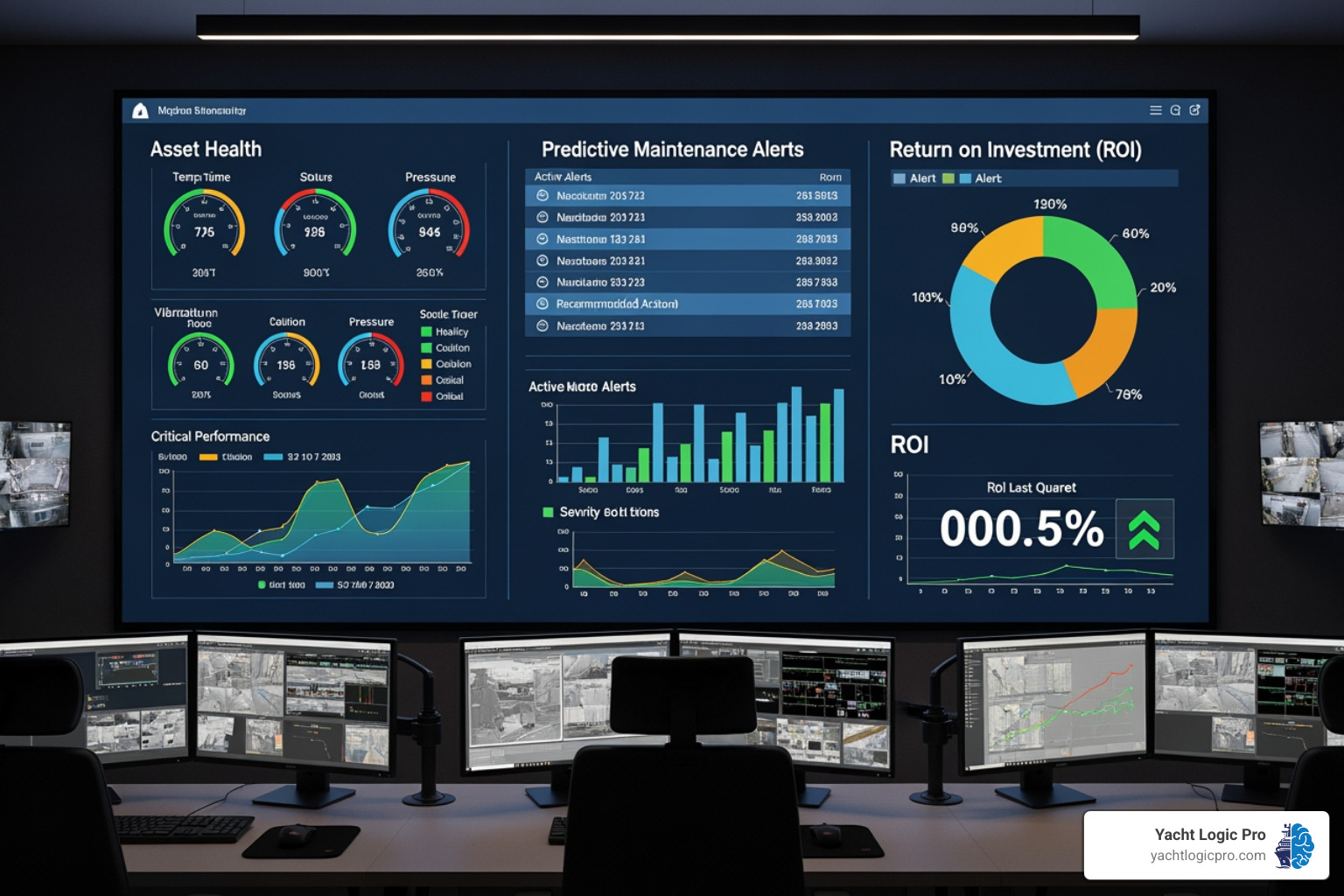
When we accept AI in our maintenance strategies, we’re looking at:
- Downtime reduction: Fewer unexpected stops mean more operational time.
- Cost savings: From reduced emergency repairs to optimized spare parts.
- Increased productivity: Equipment runs longer, and technicians work smarter.
- Safety improvements: Preventing failures means preventing accidents.
Let’s break down these benefits further.
Boosting ROI and Operational Efficiency
For businesses that rely heavily on expensive assets, like marine operations, the return on investment (ROI) from AI powered maintenance can be substantial.
- Reduced Downtime: AI-driven predictive maintenance could cut unplanned downtime by up to 50%. Imagine what that means for your charter schedule or shipyard productivity.
- Increased Asset Lifespan: By enabling timely, precise interventions, AI can increase asset lifespan by 20–40%. This means getting more years out of those costly engines, generators, and other critical components, delaying expensive replacements.
- Lower Maintenance Costs: Organizations can reduce maintenance costs by 10–40% through early intervention and less labor. This isn’t just about preventing big breakdowns; it’s also about avoiding unnecessary preventative maintenance tasks.
- Increased Production/Availability: With more reliable equipment, companies can increase productivity by 5%–20%. For a marine business, this translates to more time on the water, more services rendered, and ultimately, more revenue.
Across modern factories and service operations, AI-enabled maintenance platforms now equip maintenance workers with the data necessary to drive faster, predictive decision-making. By monitoring equipment health, detecting abnormal activities, and moving from reactive to truly proactive maintenance, these organizations are seeing substantial reductions in downtime, breakdowns, and overall maintenance costs.
Enhancing Safety and Optimizing Resources
Beyond the financial benefits, AI powered maintenance also fundamentally changes the safety and resource allocation landscape.
- Improved Worker Safety: A failing machine can imperil employees and other assets. Predicting and preventing failures improves operational safety by proactively addressing hazardous conditions before they escalate.
- Proactive Hazard Prevention: AI identifies potential issues, allowing us to implement safety measures or take equipment offline before an accident occurs. This is invaluable, especially in high-risk environments like marine operations.
- Optimized Labor Allocation: With AI handling the heavy lifting of prediction and analysis, our skilled technicians can shift their focus from emergency repairs to higher-value tasks, like strategic planning, complex diagnostics, or skill development. This leads to better utilization of human capital and less stress. We’ve seen how Why Most Marine Service Operations Fail at Scheduling and How to Fix It can be addressed with intelligent scheduling.
- Smart Spare Parts Inventory and Automated Procurement: AI doesn’t just predict when a part might fail; it can predict which part, when, and even how many might be needed. This allows for optimized spare parts inventory, reducing capital tied up in unnecessary stock while ensuring critical parts are always available. Some systems can even automate reordering based on these predictions, streamlining the procurement process and mitigating supply chain disruptions. This helps eliminate parts shortages and overspending.
Real-World Success of AI Powered Maintenance
The proof is in the pudding, as they say. Companies across various industries are already reaping the rewards of AI powered maintenance:
- Manufacturing Sector: Large manufacturing plants now use in-house machine-learning models and connected sensors to visualize fault patterns, anticipate breakdowns, and plan downtime windows in advance. These AI-supported systems save teams many hours of disruption each year and free employees for other tasks.
- Energy Sector: An electrical utility might invest in predictive maintenance for an electrical substation where downtime would leave thousands without power. AI in energy plants uses sensor signals from turbines, transformers, and other machinery to identify anomalies and predict failures, enhancing reliability and reducing operating costs.
- Aerospace Industry: Given the critical nature of aircraft components, AI-powered predictive maintenance is used to monitor engine performance, structural integrity, and various subsystems to ensure maximum safety and operational readiness.
- Marine Applications: While specific public examples are still emerging, the principles apply directly. Imagine AI monitoring a yacht’s propulsion system, climate control, or navigation equipment, predicting potential failures before a busy charter season or a long voyage. This allows marine service operations to offer truly proactive service, enhancing customer satisfaction and safety.
These examples highlight that AI powered maintenance is not just a futuristic concept; it’s a present-day solution delivering measurable results across diverse, asset-intensive industries.
Navigating the Implementation of an AI Maintenance Program
Adopting AI powered maintenance might sound daunting, but with a clear strategy, it’s an achievable goal that will transform your operations. It’s not about flipping a switch; it’s a journey that requires careful planning, the right tools, and a commitment to change.
Implementing an AI program is a strategic move that involves more than just technology; it touches on your entire operational structure, from data infrastructure to change management within your team.
Key Steps to a Successful Launch
Here are the key steps we recommend for successfully launching an AI powered maintenance program:
- Define Goals & KPIs: What do you want to achieve? Reduce downtime by X%? Cut maintenance costs by Y%? Extend asset life? Clear, measurable goals will guide your implementation and help you track success.
- Assess Data Infrastructure: AI thrives on data. Do you have sensors on critical equipment? Are your historical maintenance records digitized and accessible? You’ll need to ensure a quality stream of operational data. If not, investing in appropriate IoT sensors and a robust data collection system is your first step.
- Start with a Pilot Project: Don’t try to implement AI across your entire fleet or facility at once. Choose a critical asset or a specific type of equipment to run a pilot. This allows you to learn, refine your approach, and demonstrate early successes without overwhelming your team or resources.
- Choose the Right Tools: Select an AI-powered maintenance solution that integrates with your existing systems and is custom to your industry’s needs. For marine businesses, an all-in-one, AI-powered marine maintenance and operations software is ideal, automating maintenance, managing technicians, tracking inventory, and syncing finances. This helps unify operations and eliminate manual data entry.
- Train Your Team: AI isn’t replacing technicians; it’s empowering them. Provide comprehensive training on the new tools, how to interpret AI insights, and how their roles will evolve. Empowering your team with Digital Tools Every Marine Technician Should Be Using in 2025 is crucial for successful adoption.
Overcoming Common Challenges
While the benefits are clear, implementing AI powered maintenance isn’t without its challenges. But with foresight, these can be effectively managed:
- Data Quality and Availability: Poor data in equals poor insights out. Ensuring clean, consistent, and comprehensive data from sensors and historical records is paramount. This might require an initial investment in data clean-up and robust data collection systems.
- System Integration: Integrating new AI platforms with existing Computerized Maintenance Management Systems (CMMS), Enterprise Resource Planning (ERP) systems, or other operational software can be complex. Choosing a solution designed for seamless integration is critical.
- Initial Investment: There’s an upfront cost associated with sensors, software, and potentially new infrastructure. However, the long-term ROI typically far outweighs this initial outlay.
- Skill Gaps: Your team might need new skills to work with AI tools. Investing in training and upskilling is essential to ensure adoption and maximize the value of the new system.
- Securing Buy-in: Change can be hard. Clearly communicating the benefits to all stakeholders—from executives to frontline technicians—and demonstrating early successes can help secure the necessary buy-in. When looking for new systems, always consider What to Look For in Yacht Service Management Software: A Buyer’s Checklist.
By addressing these challenges proactively, we can ensure a smoother transition and a more successful implementation of your AI powered maintenance program.
Frequently Asked Questions about AI Powered Maintenance
We know you might have more questions, so let’s tackle some of the common ones we hear about AI powered maintenance.
Which industries benefit most from AI-powered maintenance?
While the marine industry stands to gain immensely, AI powered maintenance is particularly beneficial for any asset-heavy industry where equipment downtime is costly, and safety is paramount. This includes:
- Manufacturing: Reducing breakdowns on production lines.
- Energy (Oil & Gas, Utilities): Ensuring continuous operation of critical infrastructure like turbines and power grids.
- Aerospace: Maintaining complex aircraft systems for safety and efficiency.
- Logistics & Transportation: Keeping fleets of vehicles, trains, or ships running smoothly.
- Marine Industry: From commercial shipping to yacht management, where environmental conditions are harsh and reliability is key.
Essentially, if you have expensive machinery that absolutely has to work, AI can help.
How does AI help with spare parts inventory?
This is one of the often-overlooked but incredibly powerful benefits of AI powered maintenance. AI transforms spare parts management in several ways:
- Predicts Part Needs: By knowing when an asset is likely to fail, AI can also predict which specific component will need replacement. This allows us to order parts just-in-time.
- Automates Reordering: Some advanced systems can automatically trigger reorder requests when stock levels are low or when a predicted failure necessitates a specific part.
- Reduces Overstocking: By having precise forecasts, businesses can significantly reduce the amount of capital tied up in excess inventory, freeing up cash flow.
- Prevents Shortages: Conversely, AI ensures that critical parts are always on hand when needed, preventing delays due to out-of-stock items.
- Optimizes Capital: Limiting spare equipment and capital tied up in unneeded parts is a significant financial benefit.
This precision in inventory management leads to substantial cost savings and improved operational efficiency.
Is AI meant to replace maintenance technicians?
Absolutely not! This is a common misconception, and we want to be very clear: AI powered maintenance is designed to augment, not replace, the skills of human technicians. Think of AI as a powerful co-pilot:
- Empowers Technicians: AI provides technicians with unprecedented insights into equipment health, allowing them to make more informed decisions and perform maintenance more effectively.
- Augments Skills: It acts as a smart assistant, highlighting likely issues, suggesting relevant procedures, and surfacing insights based on the current task. This means even less experienced technicians can perform complex diagnostics with greater confidence.
- Automates Repetitive Tasks: AI eliminates the burden of time-consuming, repetitive administrative tasks, allowing maintenance teams to focus on high-impact work. This includes automated work order creation, scheduling, and documentation.
- Focus on High-Value Work: By handling the predictive analysis and automating routine tasks, AI frees up technicians to focus on complex problem-solving, strategic planning, and hands-on repairs that truly require human expertise.
AI helps us move from “fighting fires” to “feeling calm,” as one manager put it. It transforms the day-to-day of a marine service manager, as detailed in A Day in the Life of a Marine Service Manager Using Yacht Logic Pro. Our technicians become more efficient, more strategic, and ultimately, more valuable.
Conclusion: The Future is Proactive, Not Reactive
We’ve journeyed through the evolution of maintenance, explored the technologies powering AI, dug into the tangible benefits, and addressed common concerns. It’s clear that AI powered maintenance isn’t just a trend; it’s the inevitable and beneficial future of asset management.
This shift means moving away from the costly cycles of reactive repairs and over-scheduled preventative maintenance. Instead, we accept a data-driven, proactive approach that predicts issues before they become problems, optimizes resources, and improves safety. The statistics speak for themselves: significant reductions in downtime and costs, coupled with extended asset lifespans and increased productivity.
For marine businesses, this change is particularly impactful. Imagine a world where your vessels are always ready, your equipment performs optimally, and your maintenance budget is managed with precision. This future is not only possible; it’s here.
By empowering our workforce with intelligent tools and embracing data-driven decisions, we’re not just fixing things better; we’re building more resilient, efficient, and profitable operations. This is the essence of The Future of Marine Service is Digital: Here’s How to Get Ahead in 2025.
At Yacht Logic Pro, we believe in this future. Our all-in-one, AI-powered marine maintenance and operations software is designed to automate maintenance, manage technicians, track inventory, and sync finances for service-driven marine businesses. We aim to save you time and boost your profits by unifying your operations and eliminating manual data entry, so you can focus on what you do best: delivering exceptional marine service.
Ready to transform your maintenance strategy and lift your marine business? Explore the features of AI-powered marine operations software today and step into a smarter, more proactive future.