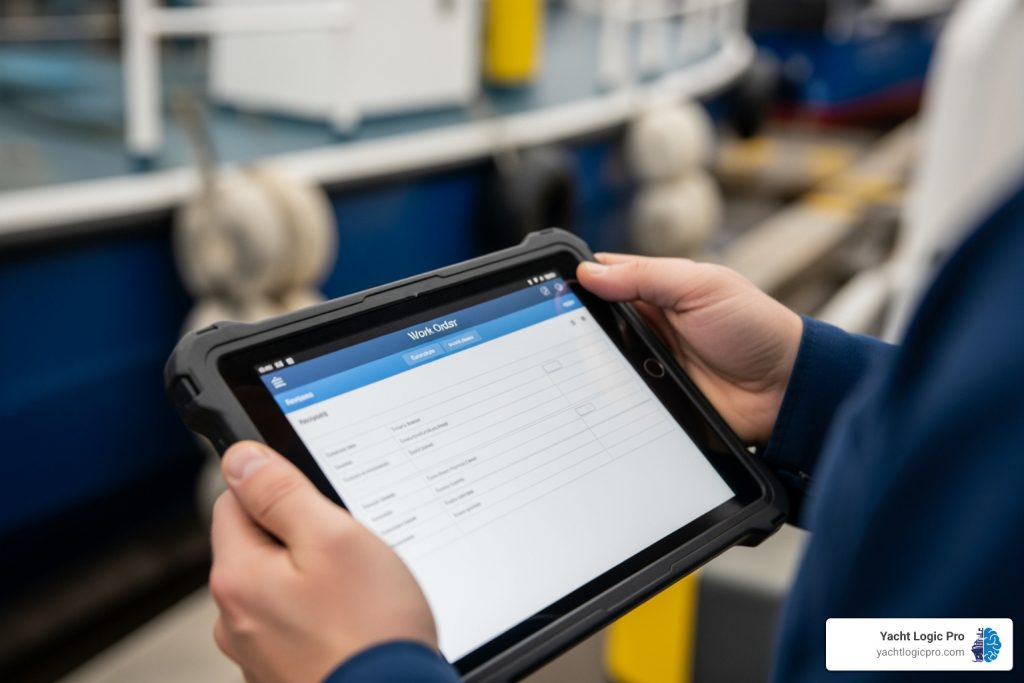


A boat maintenance app is a mobile-first tool technicians use in the field — checklists, photos, clock-in/out. Boat maintenance software is the full back-office system running scheduling, inventory, invoicing, and reporting for the whole business. Most growing marine businesses eventually need both, which is why Yacht Logic Pro ships them as one connected platform instead of two separate tools you have to reconcile manually.
What a “boat maintenance app” actually does
A dedicated app is built for technicians on the boat or dock, not the office:
- Digital checklists and inspection forms
- Photo/video documentation attached to a job
- Clock in/out with GPS location tracking
- Parts requests submitted from the field
- Service reports completed on-site, not written up later
What “boat maintenance software” actually does
The software layer is what runs the business behind those field updates:
- Job scheduling and technician dispatch
- Job costing and profitability tracking per job
- Inventory and parts management (often with barcode scanning)
- Invoicing, and two-way sync with accounting tools like QuickBooks Online
- Customer/lead management and service history
App-only vs. software-only vs. a combined platform
| App-only tool | Software-only (desktop/office) | Combined platform (Yacht Logic Pro) | |
| Field data capture (photos, checklists, GPS) | Yes | No | Yes |
| Job scheduling & dispatch | Limited | Yes | Yes |
| Inventory & parts tracking | Rare | Yes | Yes |
| Invoicing / QuickBooks sync | No | Sometimes | Yes (two-way) |
| Data flows automatically between field and office | No — manual re-entry | N/A | Yes |
| Best for | Solo technicians logging basic job notes | Office-only staff with no field team | Shops with both technicians and office/admin staff |
Signs an app-only tool isn’t enough anymore
If any of these sound familiar, you’ve outgrown a standalone app:
- Your office staff re-types information technicians already entered in the field
- Technicians can’t see a boat’s full service history from their phone
- Invoicing happens in a separate system that doesn’t know a job is finished
- Parts requested in the field don’t automatically hit your inventory count
How Yacht Logic Pro combines both
Yacht Logic Pro pairs a mobile field app (clock-in/out, GPS, photo uploads, parts requests) with full back-office software (AI-assisted job creation, job costing, barcode inventory, two-way QuickBooks Online sync, and customer management with digital consent forms). Everything a technician logs on the dock updates the office dashboard in real time — no double entry.
Pricing at a glance: Single-user plans start at $99/month; the 3-user annual plan (the most popular option) is $149/month, with additional users at $25–50/month. No setup fees, and training is included.
Book a Demo to see the app and back-office software running together, or see the full breakdown on the Features page.
FAQ
What’s the difference between a boat maintenance app and boat maintenance software? An app is the mobile tool technicians use in the field (checklists, photos, clock-in/out), while software is the back-office system that runs scheduling, inventory, invoicing, and reporting for the business as a whole.
Can I just use a free app instead of paying for software? A free app can work for a solo technician logging basic notes, but once you have office staff, multiple technicians, or need invoicing tied to job completion, a standalone app creates double data entry that costs more time than the software would.
Does Yacht Logic Pro include both a mobile app and back-office software? Yes — Yacht Logic Pro is one connected platform: a mobile app for field technicians (GPS, photos, parts requests, clock-in/out) synced in real time with the office dashboard (scheduling, inventory, invoicing, reporting).
How much does boat maintenance software cost? Yacht Logic Pro starts at $99/month for a single user, with a 3-user annual plan at $149/month and no setup fees.
Is there a free trial? Book a demo to see the platform live and discuss trial options based on your shop’s size and current tools.