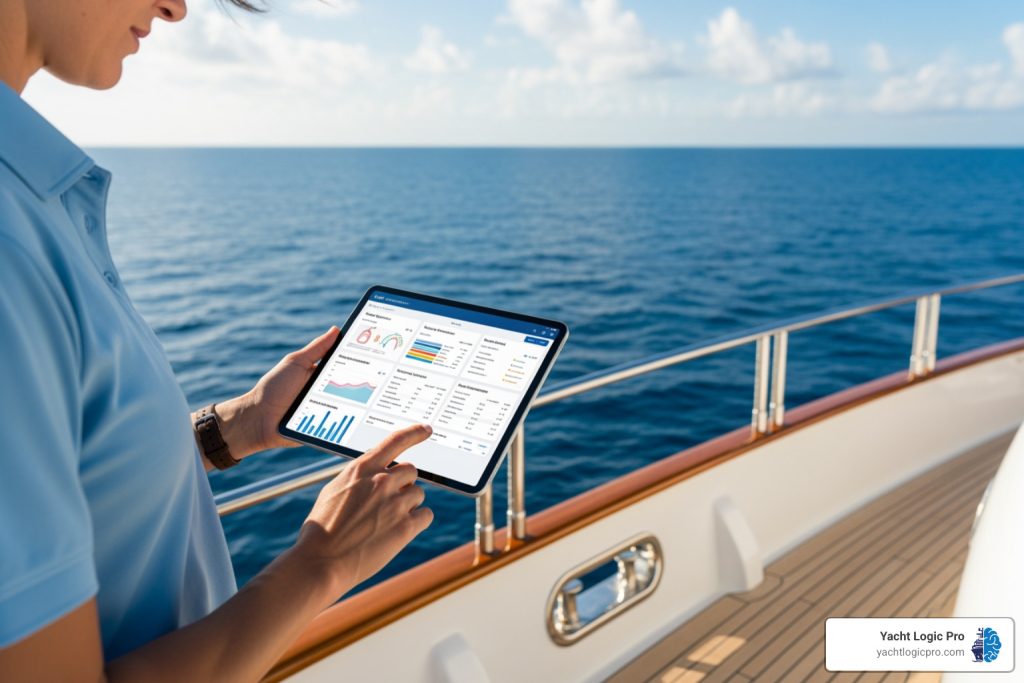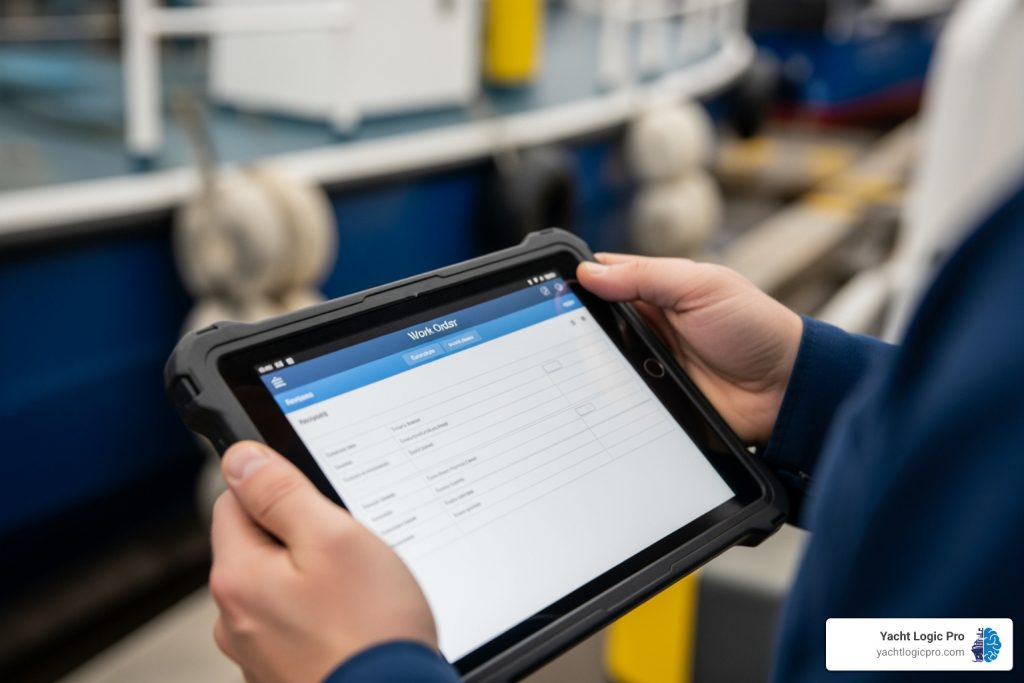


Satellite communications are no longer just a convenience for offshore cruising — they have become a critical operational layer for marine service businesses. If you manage a fleet, coordinate technicians on vessels at distant anchorages, handle remote diagnostics, or track job progress across multiple boats in various locations, reliable satellite connectivity directly affects your efficiency and your bottom line.
This guide covers the key satellite technologies available in 2026, how they compare, and — most importantly — how marine service businesses can put them to work: integrating vessel connectivity with the job management, maintenance scheduling, and fleet tracking tools that keep operations running.
Satellite Technologies Shaping Yacht Communication in 2026
The satellite communications market has shifted significantly. Four core system types now define what’s available for maritime operators, and each carries meaningful trade-offs for businesses managing vessels professionally.
VSAT, GEO, MEO, and LEO: How Each System Performs at Sea
VSAT (Very Small Aperture Terminal) systems operate through geostationary satellites and remain the workhorse for high-volume data transfer. They deliver consistent, high-speed connectivity regardless of location — which makes them well-suited for larger yacht management operations that need reliable bandwidth for remote monitoring, reporting, and real-time access to management software.
GEO (Geostationary Orbit) systems offer the broadest coverage footprint, keeping satellites fixed relative to the Earth’s surface. This predictability is valuable for operations with fixed vessel routes, but GEO’s higher altitude introduces latency — typically 600ms or more round-trip — which can affect real-time applications.
MEO (Medium Earth Orbit) and LEO (Low Earth Orbit) satellites sit much closer to the surface, which reduces latency dramatically. LEO systems in particular — Starlink being the most prominent — now deliver sub-50ms latency comparable to land-based broadband. For marine service businesses that rely on live video calls with technicians, real-time GPS tracking, or cloud-based software access, LEO’s performance advantage is material.
Why Hybrid Satellite-Cellular Connectivity Is Gaining Ground
The most practical approach for many marine service businesses in 2026 is a hybrid system combining satellite and cellular networks. The logic is straightforward:
• When vessels are within cellular range — marinas, coastal anchorages, service yards — cellular data is cheaper and often faster.
• Satellite takes over offshore, ensuring the crew, the vessel monitoring system, and your service management software stay connected regardless of location.
• If either connection drops, the other maintains continuity, reducing communication outages during active jobs.
For a mobile marine technician or a yacht management company tracking multiple vessels, this redundancy isn’t a luxury — it’s the difference between a job running smoothly and a communication breakdown mid-service.
Leading Maritime Satellite Providers in 2026
Several providers dominate the maritime satellite market. Understanding what each does best helps marine service businesses match the right solution to their operational needs.
| Provider | Primary System | Best For | Coverage |
| Inmarsat | VSAT + Broadband | Fleet operators needing high-speed data across global routes | Global |
| KVH Industries | Cellular + Satellite Hybrid | Cost-conscious operators who want to minimize satellite usage in coastal zones | Global & Regional |
| Intellian | Antenna Systems (LEO/GEO) | Businesses prioritizing LEO speed and low-latency remote monitoring | Global |
| Marlink | Managed Connectivity | Yacht management companies needing tailored multi-vessel solutions | Extensive |
A Note on Starlink for Maritime
Starlink Maritime (SpaceX’s LEO offering) has become a compelling option for smaller and mid-size marine operations in 2026. Its flat-rate pricing model and high performance in coastal and offshore zones make it competitive for yacht management companies and service businesses that need predictable monthly data costs without sacrificing speed.
Integrating Satellite Connectivity with Marine Service Management Software
This is where satellite communications become directly relevant to how you run your marine service business — not just how vessels stay connected, but how that connectivity links your field operations back to your management systems.
Real-Time Job Management from Vessel to Shore
When your technicians are aboard a vessel at anchor or offshore, satellite connectivity allows them to access your job management system in real time. That means:
• Technicians can open work orders, log time, and update job status from the boat — no waiting until they return to the dock to sync records.
• Parts requests can be submitted on the spot, triggering inventory checks and procurement from your shore-based team.
• Job cost data — labor hours, parts used, time on task — flows back to your management software as the work happens, not at the end of the day.
Yacht Logic Pro’s mobile app (iOS and Android) is built for exactly this kind of field-to-office workflow. Technicians can create and update jobs, log hours, and access customer history from anywhere — including from vessels connected via satellite. Learn more at yachtlogicpro.com/features.
Preventive Maintenance Scheduling Across a Fleet
One of the highest-value applications of satellite connectivity for marine service businesses is preventive maintenance management. When a vessel’s systems — engine hours, generator runtime, navigation equipment — transmit data back to shore via satellite, that data can feed directly into your maintenance scheduling system.
Rather than relying on paper logs or waiting for the captain to report engine hours on return, connected vessels can trigger maintenance alerts automatically. For a yacht management company or marina service operation managing multiple vessels, this removes one of the most common sources of missed service intervals and reactive repair costs.
Yacht Logic Pro includes preventive maintenance scheduling built into the core platform — no add-on required. See how it works: Preventive Maintenance Scheduling for Marine Service Businesses.
Fleet Tracking and GPS Integration
For marine service businesses managing multiple vessels — whether a charter fleet, a yacht management portfolio, or a service operation covering a large waterway — satellite-enabled GPS tracking provides real-time vessel location data that supports better dispatch, job routing, and client communication.
Knowing exactly where each vessel is at any given time eliminates the guesswork of scheduling technician visits, estimating arrival times for parts delivery, and coordinating multi-vessel service days. Yacht Logic Pro includes GPS navigation features to support exactly this kind of fleet-level coordination.
Remote Diagnostics and IoT Monitoring
IoT (Internet of Things) sensors are increasingly standard equipment on commercial and managed yachts. These sensors monitor engine performance, fuel consumption, bilge levels, battery systems, and more — transmitting data continuously when connected via satellite.
For a marine service business, this data is operationally valuable:
• Anomalies can trigger automatic service alerts before a system failure occurs.
• Technicians arriving at a vessel for a scheduled service already have system performance data before they board.
• Clients receive proactive communication about vessel health, strengthening the service relationship.
The combination of IoT monitoring and marine management software that can act on that data — creating work orders, scheduling technicians, ordering parts — is becoming a meaningful competitive differentiator for forward-thinking marine service businesses.
Installation and Maintenance: What Marine Service Businesses Should Know
Whether you’re advising clients on satellite installations or managing connectivity for vessels in your own fleet, understanding the installation and maintenance requirements for marine satellite systems helps you set expectations and deliver better service.
Key Steps in a Marine Satellite Installation
A proper marine satellite installation involves:
• Site survey: Assessing the vessel structure, mast height, obstructions, and optimal antenna placement for clear sky view.
• Antenna mounting: Securing the dish or phased-array antenna to withstand offshore conditions — vibration, salt spray, and wind loading.
• Cable routing and weatherproofing: Running cables through the vessel with proper sealing at every penetration point.
• System configuration: Setting network parameters, firewall rules, and bandwidth management to match the crew’s usage profile and your management software’s requirements.
For any marine service business that offers electronics installation, satellite system work is a growing revenue line as more vessel owners invest in connectivity upgrades.
Maintaining Satellite Systems for Reliable Performance
Satellite equipment in marine environments degrades faster than in terrestrial installations. Salt air, UV exposure, and constant vibration take their toll on antenna mounts, connectors, and coax. A maintenance routine should include:
• Regular visual inspection of antenna mounts and cable runs for corrosion and wear.
• Cleaning radome surfaces to maintain signal integrity.
• Firmware updates to ensure the modem and antenna controller stay current.
• Annual connection testing to catch cable degradation before it causes outages.
Documenting these maintenance tasks in a vessel’s service record — and triggering reminders on the right intervals — is exactly the kind of recurring work that a preventive maintenance scheduling system is built to manage.
Pricing Models and Cost Management for Marine Satellite Services
Understanding satellite pricing helps marine service businesses advise clients accurately and manage their own connectivity costs.
How Satellite Data Pricing Works in 2026
Most satellite providers offer tiered data plans with monthly fees. The key pricing variables are:
• Data volume: Higher-tier plans allow more GB per month before throttling or overage charges.
• Committed information rate (CIR): Some enterprise plans guarantee minimum speeds, important for businesses relying on real-time software access.
• Hardware costs: Antenna systems range from under $1,000 (basic LEO terminals) to $20,000+ for high-throughput VSAT systems.
• Installation and maintenance fees: Often separate from service contracts.
Controlling Costs Without Sacrificing Connectivity
For marine service businesses managing satellite costs across a fleet or advising clients on their connectivity spend, three strategies consistently reduce waste:
• Hybrid cellular/satellite routing: Configure systems to use cellular data when in range and satellite only offshore. This alone can cut satellite data consumption by 30-50% for coastal operations.
• Application prioritization: Ensure management software, monitoring data, and communications get bandwidth priority over lower-value traffic like streaming.
• Volume purchasing: Multi-vessel operators can often negotiate pooled data plans that are significantly cheaper than individual vessel contracts.
What Marine Service Businesses Should Watch in 2026 and Beyond
LEO Latency Is Changing What’s Possible Offshore
The commercial rollout of high-density LEO constellations — led by Starlink but with O3b mPOWER (MEO) also maturing — means that the latency gap between offshore and onshore connectivity is closing fast. By end of 2026, sub-100ms latency will be the norm for most managed maritime operations rather than the exception. This unlocks cloud-based management software, video diagnostics, and real-time fleet visibility that was impractical at 600ms GEO latency.
IoT and Automation Are Raising the Bar for Fleet Monitoring
As IoT sensor costs drop and satellite bandwidth expands, the amount of real-time vessel data available to marine service businesses is increasing rapidly. The businesses that build workflows to act on that data — automated maintenance alerts, predictive parts ordering, proactive client communication — will have a structural efficiency advantage over those still waiting for manual reports.
Marine Management Software Is the Hub, Not the Satellite
Satellite connectivity is the pipe. The value it delivers to a marine service business depends on what that connection feeds into. A technician who can update a work order from an offshore vessel only creates business value if the management system receiving that update can trigger the next steps — invoicing, parts ordering, scheduling the follow-up visit.
That integration between field connectivity and back-office operations is where marine service businesses will see the biggest returns from satellite investment in the years ahead.
About Yacht Logic Pro
Yacht Logic Pro is marine business management software built for boat repair shops, service yards, mobile marine technicians, and yacht management companies across the United States. Features include AI-powered job creation, preventive maintenance scheduling, parts and inventory management, built-in e-signatures (YachtSign Pro), QuickBooks Online sync, GPS navigation, and a full mobile app for field technicians. No setup fees. No hidden fees. All features included.
| Running a marine service business? Yacht Logic Pro helps boat repair shops, marine service teams, and yacht management companies manage jobs, track parts, schedule preventive maintenance, and stay connected — from the shop to the dock. Built by marine industry professionals, for marine businesses. Book a Free Demo |
Related Articles
| Related Articles | |
| Marine Business Management Software: Full Features Guide Everything Yacht Logic Pro does for marine service businesses. | Preventive Maintenance Scheduling for Boat Repair Shops How to stop missing service intervals and losing repeat business. |
| How to Run a Marine Service Business More Efficiently in 2026 Operational strategies for boat repair shops and service yards. | Yacht Logic Pro Pricing — Plans for Marine Service Teams From solo mobile technicians to multi-user service operations. |